

The used-EV market is sending dealers two different signals. Retail demand is improving and several electric models are moving quickly. At the same time, wholesale EV values showed renewed softness in mid-October. That combination deserves attention, but it is not a blanket buying recommendation.
A stronger EV market does not automatically make every used EV a profitable acquisition. The opportunity is where local scarcity, wholesale cost, battery condition, payment affordability, and a realistic retail exit all line up.
Used EVs are selling faster. But which ones?
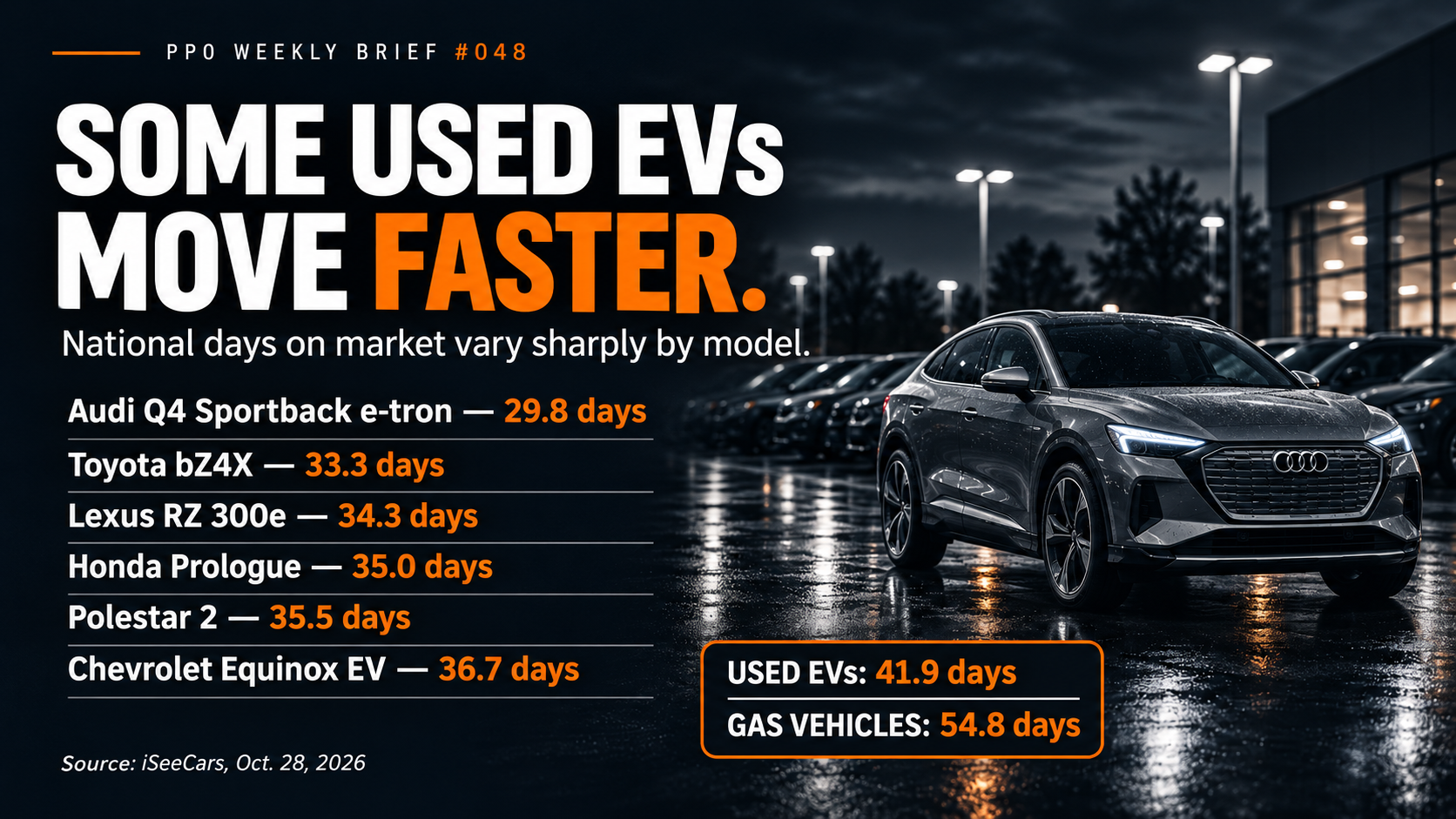
An October 28 iSeeCars analysis of more than 1.5 million one- to five-year-old vehicles reported that used EVs averaged 41.9 days on the market in September, versus 54.8 days for gasoline vehicles. Used-EV asking prices rose 9.8% year over year, compared with 0.3% for gas vehicles. That is a meaningful national signal, not a guaranteed dealership turn rate.
| Used EV model | Average days on market |
|---|---|
| Audi Q4 Sportback e-tron | 29.8 |
| Toyota bZ4X | 33.3 |
| Lexus RZ 300e | 34.3 |
| Honda Prologue | 35.0 |
| Polestar 2 | 35.5 |
| Chevrolet Equinox EV | 36.7 |
The same study reported much longer averages for the GMC Sierra EV and Cadillac Escalade IQ. One powertrain category, radically different retail outcomes.
PPO operator decision: Treat national model rankings as a research list. Validate local like-mine days' supply, 15–20 relevant retail comps where available, and the store's expected gross before buying.
Retail demand is improving while wholesale values soften
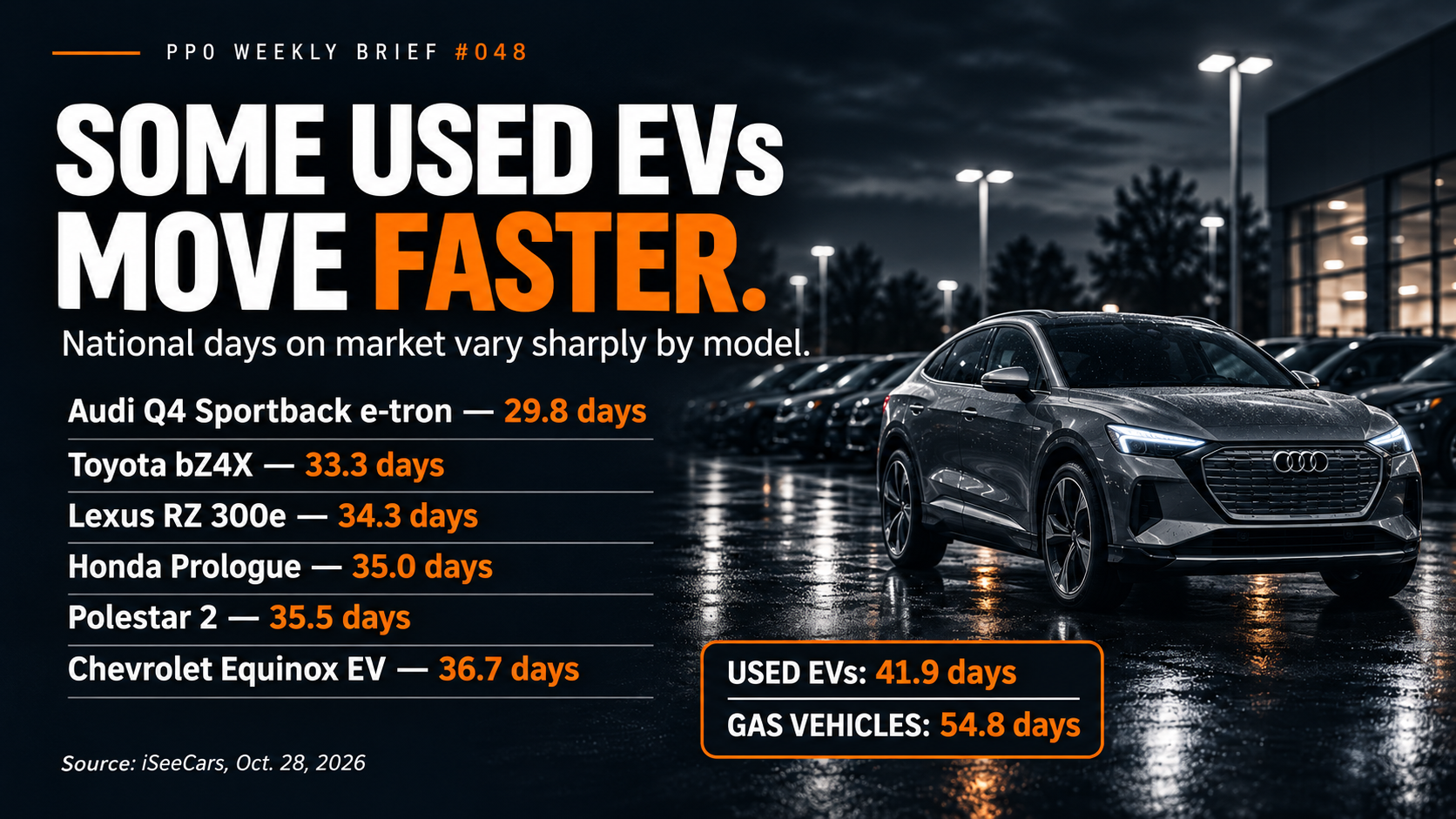
The Cox Automotive September EV Market Monitor estimated 47,862 used-EV sales, up 21.2% year over year. Used-EV days' supply was 35 versus 46 for non-EVs.
Meanwhile, Manheim's mid-October report showed EV wholesale values down 0.7% from September while non-EV values gained 0.7%. EV wholesale prices were still 6.8% above their year-earlier levels. This is a divergence worth testing, not evidence of an EV price collapse.
Analyst inference: If acquisition costs decline faster than comparable retail asking prices in a specific local market, the potential spread may improve. But the spread must be measured VIN by VIN, not assumed from two broad indexes.
PPO operator decision: Check auction transaction trends, recent MMR, current competition, recon, transport, and the realistic frontline price before committing capital. Review existing aged EVs against replacement cost.
Battery health must become an appraisal gate
Research from AVILOO, based on more than 500,000 battery tests, reported substantial variation in battery state of health. The important operator lesson is that two similar-mileage EVs can carry different battery risks. Aggregate battery-health benchmarks do not replace a VIN-specific assessment, and diagnostic providers' results should be evaluated with their methods and commercial interests in mind.
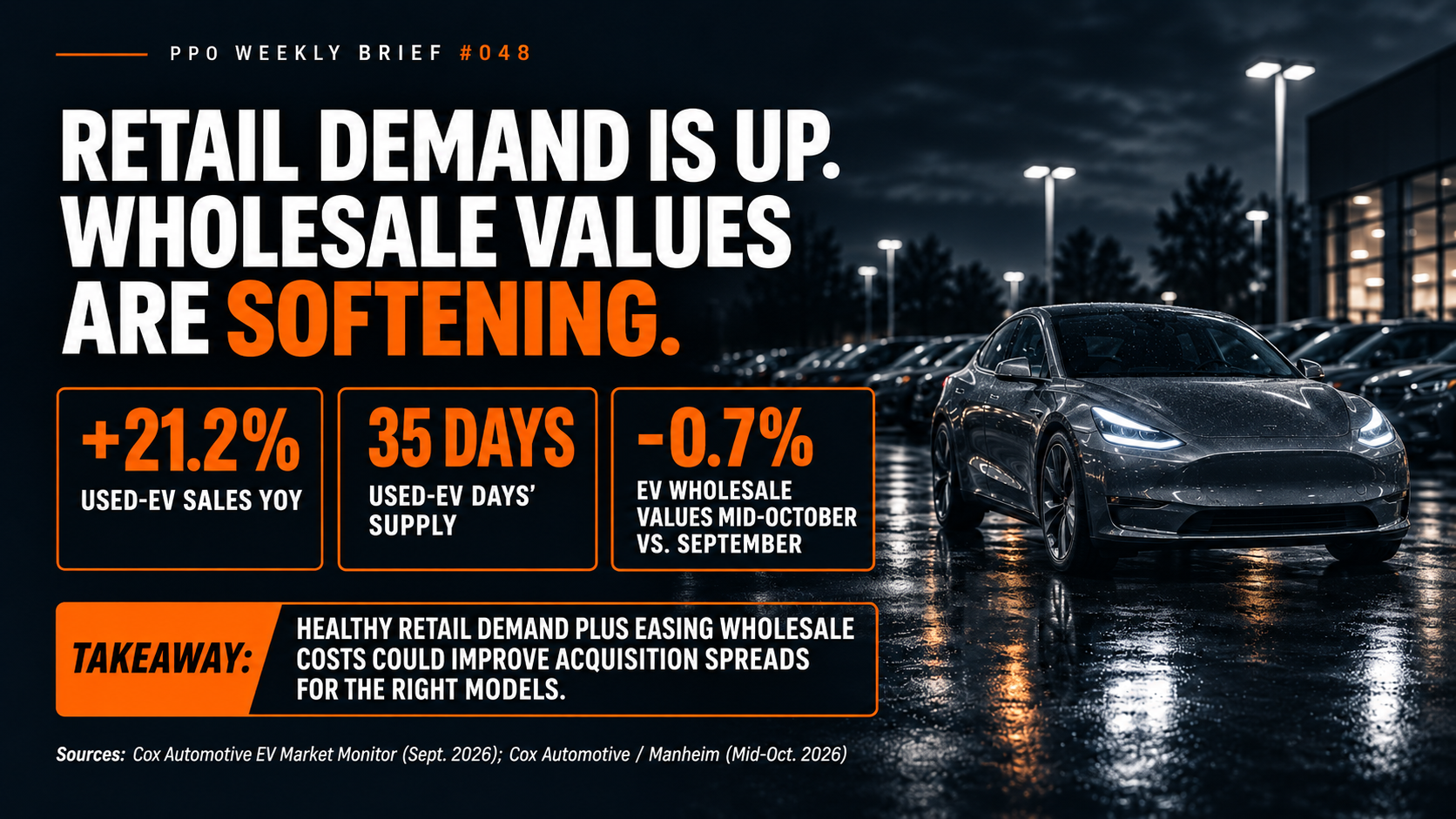
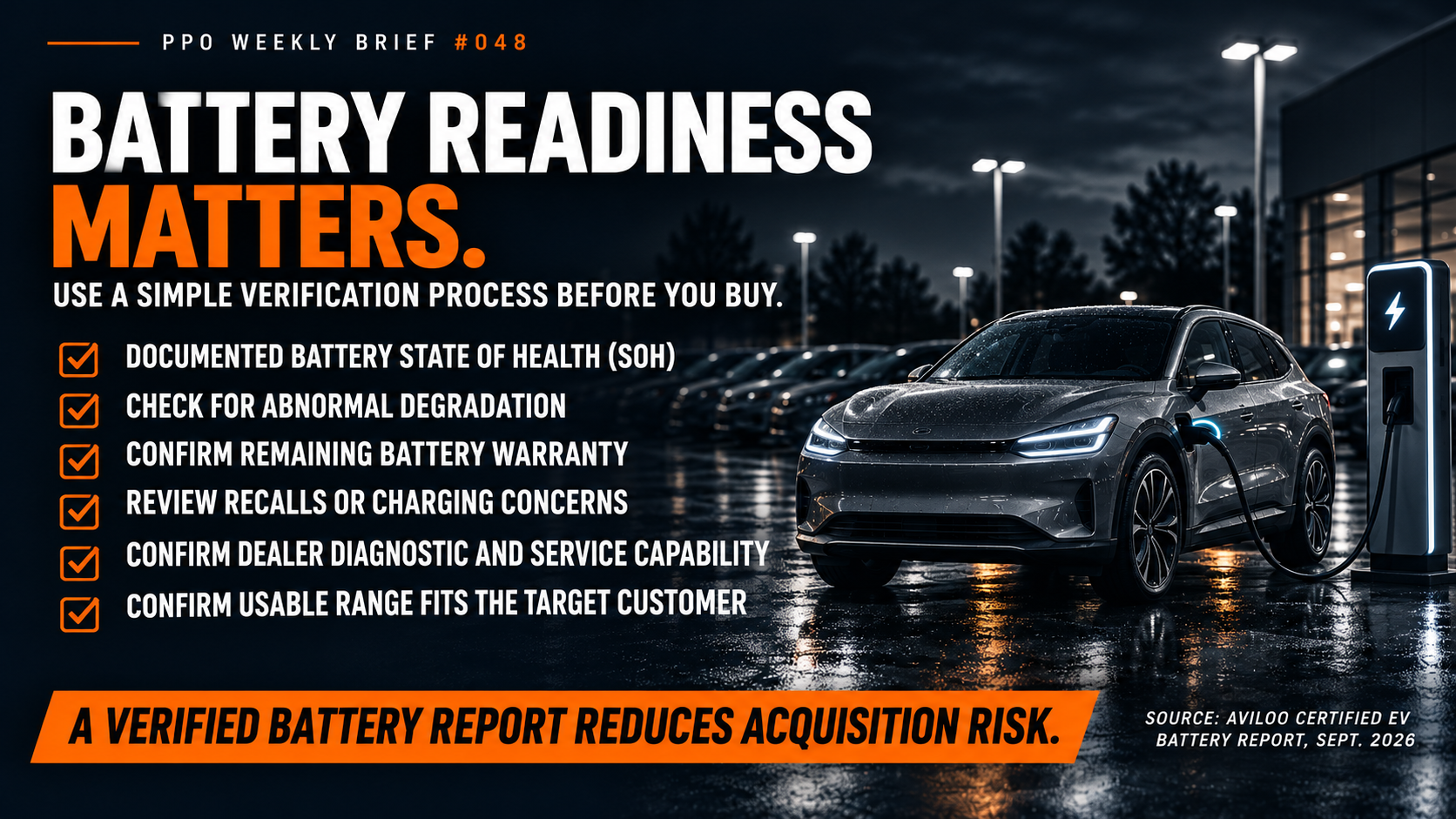
Before acquisition, ask: What documented state of health is available? Are any battery, charging, or thermal-management faults present? What warranty coverage remains? Are there open recalls or repair delays? Can this store support the model's service and parts requirements? Does usable range fit the intended customer?
PPO operator decision: When battery condition cannot be verified, price that uncertainty in the appraisal. Do not assume either a battery-health premium or discount without retail evidence.
This is the same logic behind our used-EV appraisal consistency guide: make the decision repeatable rather than relying on one buyer's confidence.
Affordable EVs may offer a different opportunity than premium models
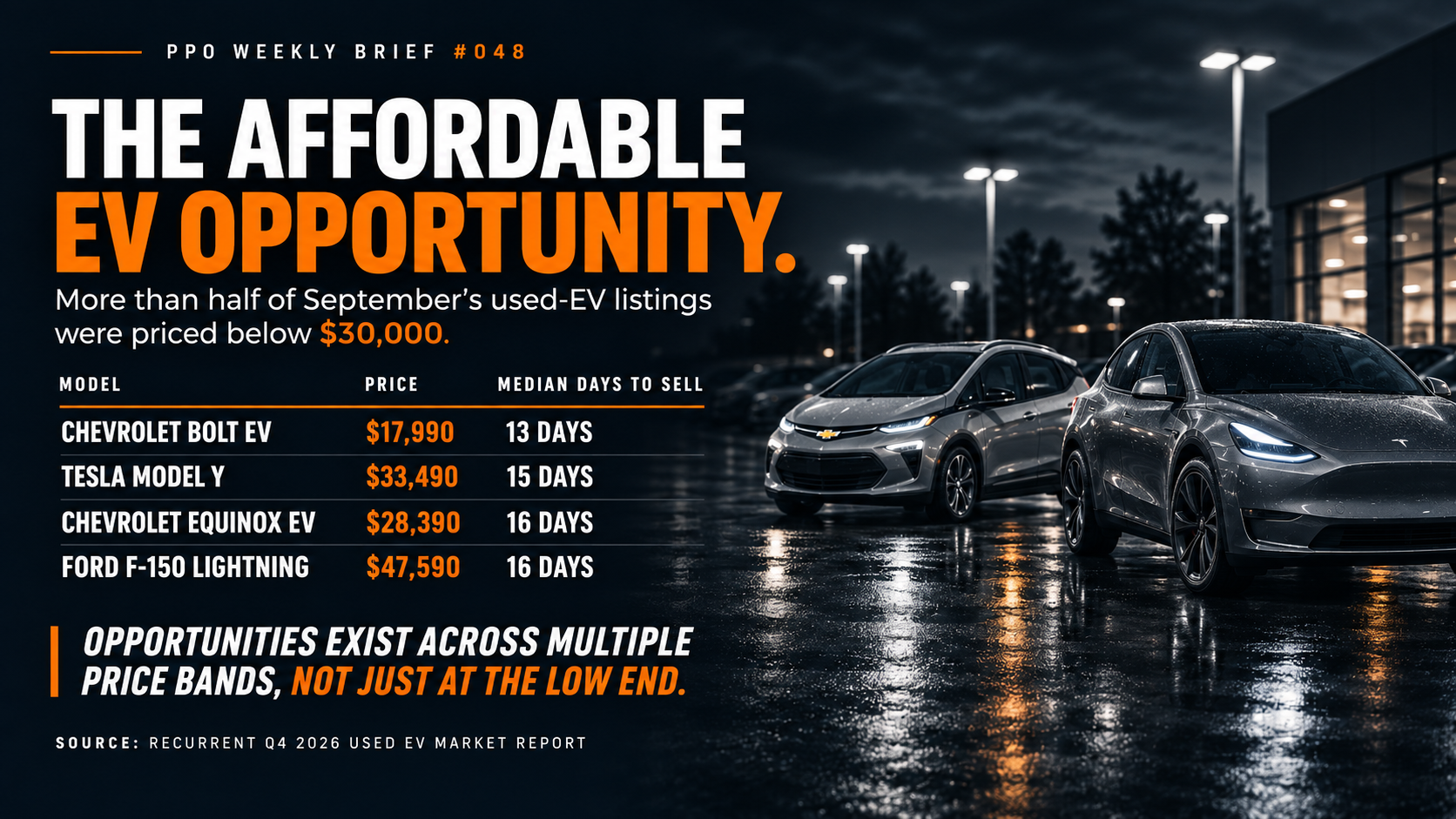
Recurrent's Q4 used-EV report found that more than half of September used-EV listings were under $30,000. Its June–September listing analysis highlighted the Chevrolet Bolt EV (median list price $17,990), Chevrolet Equinox EV ($28,390), Tesla Model Y ($33,490), and Ford F-150 Lightning ($47,590) among models with short measured selling times.
That is not one customer segment. A Bolt buyer and a Lightning buyer face different payment, insurance, lending, and ownership tradeoffs. Even different studies of model-level days on market can disagree because of varying samples, dates, and definitions. Treat these as leads for research rather than a final stocking list.
PPO operator decision: Compare candidates within relevant selling-price and estimated payment bands. Validate local comps and vehicle-specific economics before creating a Stockwave buy list.
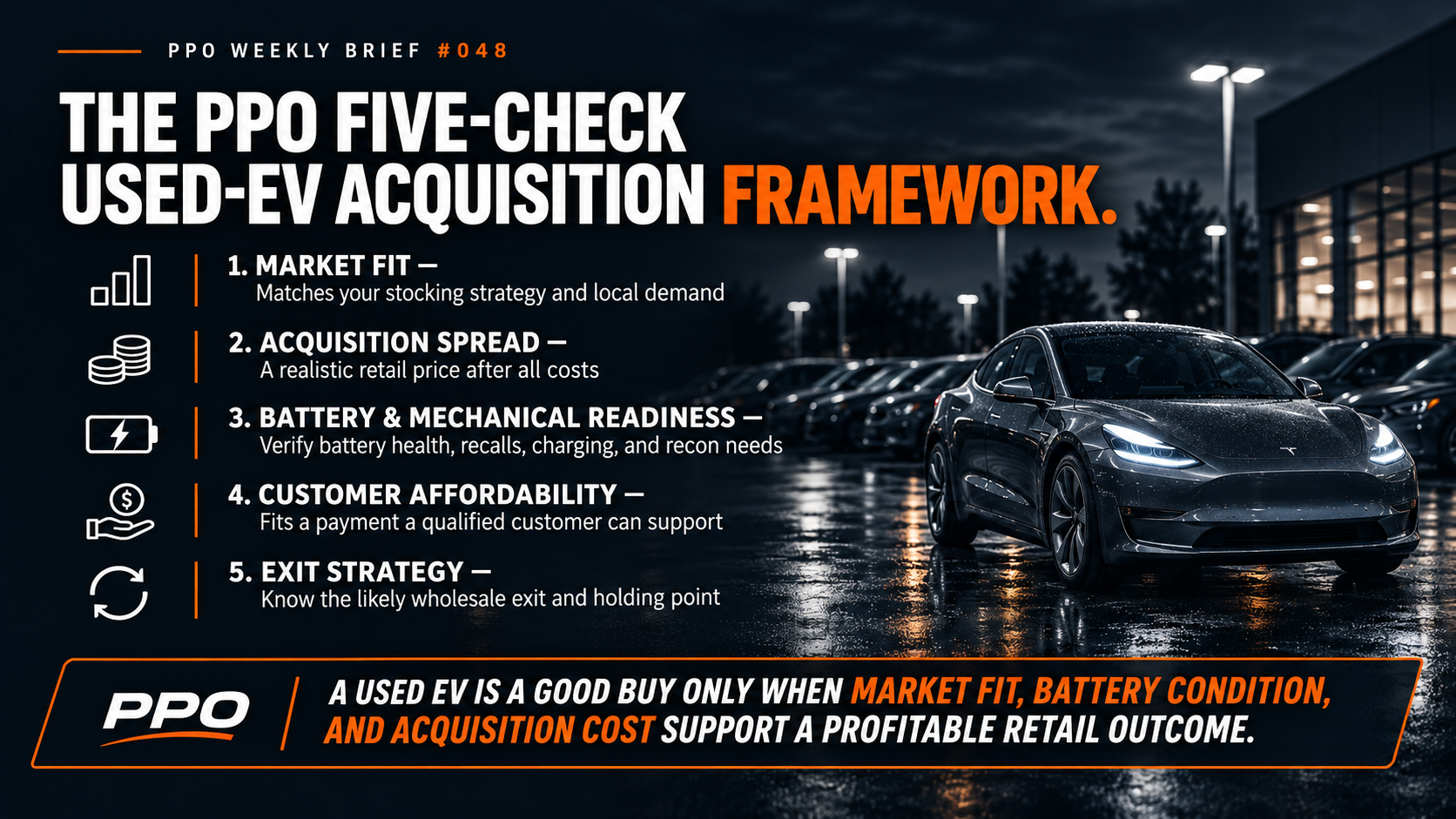
Five checks before buying a used EV
1. Market fit
Does the vehicle belong in this store's stocking strategy? Check local supply, retail competition, exact equipment, mileage, and realistic turn. Scarcity in a national report does not prove scarcity at the store.
2. Acquisition spread
Start with defensible retail value. Back out the purchase price, auction and transportation charges, expected reconditioning, carrying exposure, and required gross. Our article on pricing inventory friction into an appraisal explains why theoretical spread is not the same as usable gross.
3. Battery and frontline readiness
Document battery health when possible, charging performance, open recalls, warranty, tires, diagnostics, and serviceability. A cheap purchase can become an expensive parked car.
4. Affordability
A competitive listing price is not automatically a financeable monthly payment. Test estimated payments and lender fit rather than inferring affordability from national listing prices.
5. Exit discipline
Know the wholesale exit and monitor replacement cost before aging becomes an expensive surprise. Review when added certification cost earns its return where CPO is a realistic choice.
What Black Book adds
Black Book's September retention report recorded a 3.1% month-over-month drop in its broad used-vehicle retention index. That is not an EV-specific depreciation number. It reinforces the need to measure current vehicle-level value rather than applying an overall market average to every appraisal.
The opportunity is in the individual vehicle
I wouldn't ask whether dealers should stock more EVs. I would ask which used EVs are becoming more attractive to acquire without giving away retail profitability. The Equinox EV, Ariya, IONIQ 5, bZ4X, and Model Y are reasonable models to investigate. None is automatically a buy. Verify market fit, total investment, battery confidence, and the exit before the bid.
PPO Rule: A used EV isn't a good buy because EV demand is improving. It's a good buy when market fit, battery condition, and acquisition cost support a profitable retail outcome.
Get ahead of the market with the PPO Brief
Every week, Profitable Pre-Owned translates wholesale, retail, pricing, and inventory signals into actionable operator decisions.
If you're not ahead of the curve, you're behind it.