
Certified vehicles can carry a higher asking price. That does not automatically mean the added price pays for certification.
The decision has to be made vehicle by vehicle, against the competitive set that a shopper is actually considering and the cost your store will incur to certify the unit.
CPO is a meaningful part of the market. That is only the starting point.
Reported by Cox Automotive: September 2026 certified pre-owned sales were estimated at 213,525 units. Sales were up 10% year over year and down 6% from August. CPO represented 15.8% of used retail sales, compared with 15.2% in August.
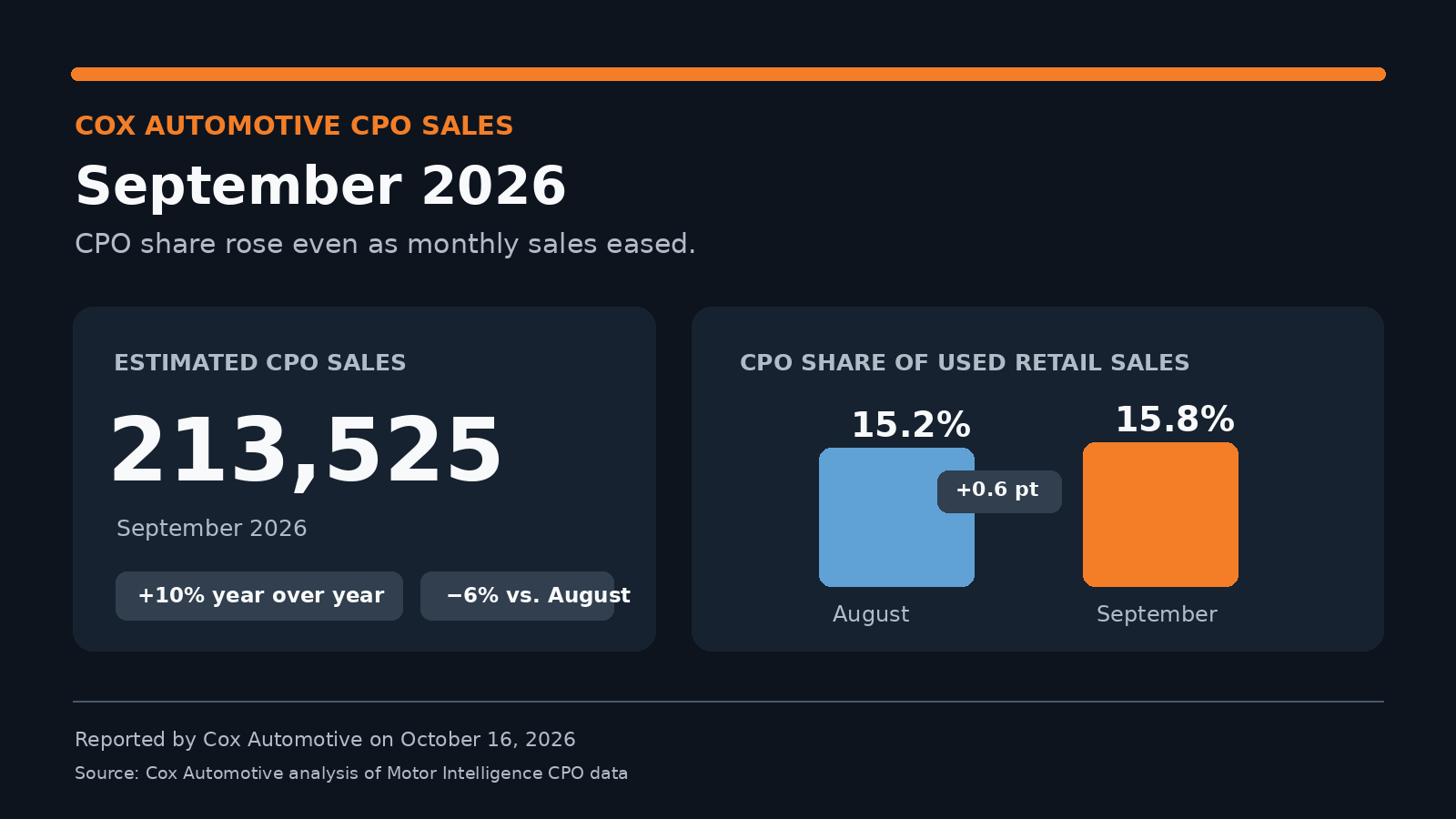
Cox Automotive’s September used-vehicle inventory report and its CPO sales chart establish that buyers are purchasing a substantial number of certified vehicles.
PPO interpretation: That market activity does not tell us whether certification is worth its cost on a particular vehicle. A growing CPO segment is a reason to test the opportunity, not a reason to certify every eligible unit.
One model can show a clear CPO advantage. Another may not.
Two recent vAuto competitive-set reviews illustrate why certification should be evaluated at the vehicle level. These are local market snapshots—not a claim that every dealer or model will see the same result.
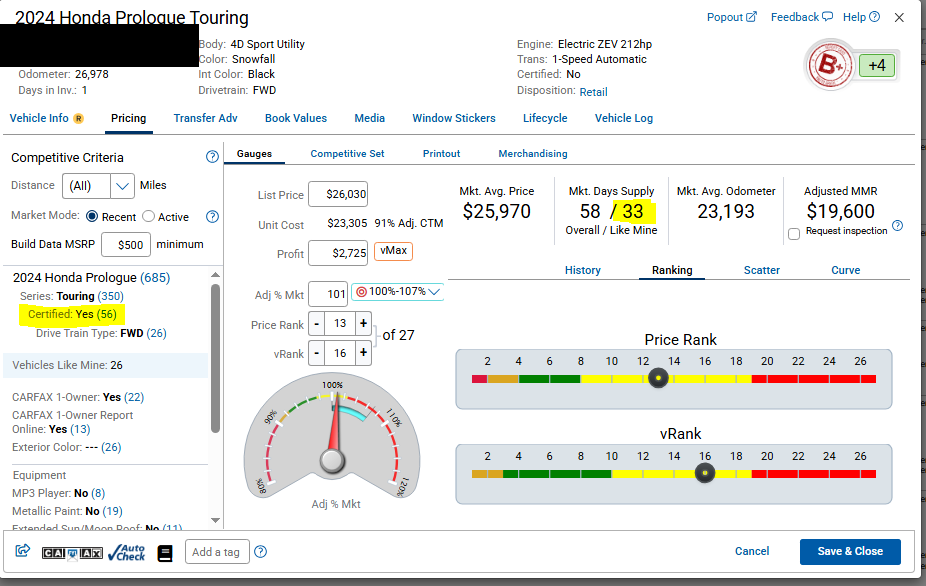
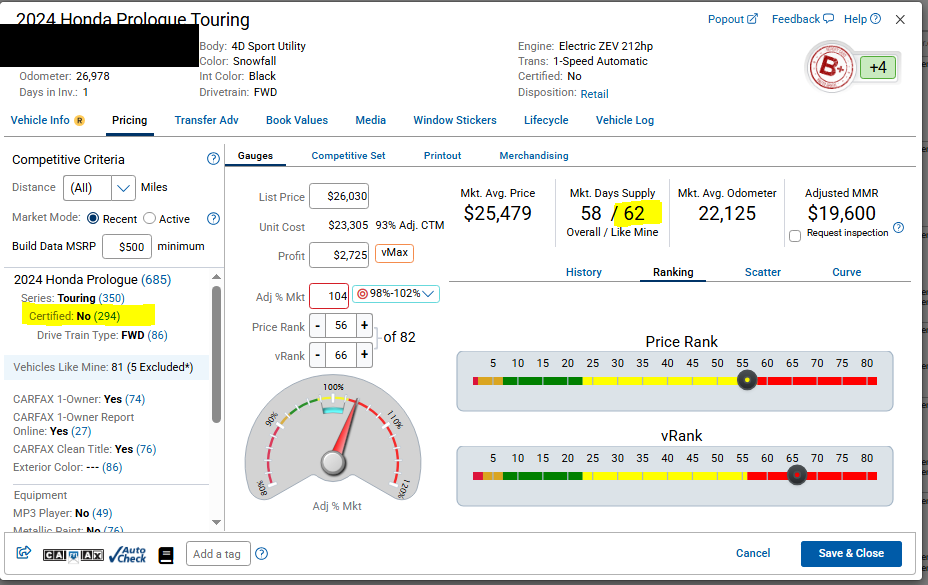
2024 Honda Prologue Touring: CPO comps showed a tighter like-mine market
CPO COMP SET
NON-CPO COMP SET
| Competitive set | Like-mine days’ supply | Average listing price |
|---|---|---|
| CPO | 33 days | $25,970 |
| Non-CPO | 62 days | $25,479 |
In this view, the CPO like-mine set was 29 days tighter, while its average listing price was $491 higher. That is a useful market signal: certification appears to align with stronger scarcity for this configuration, and the asking-price comparison is close enough to make the CPO option worth testing against the actual certification cost and store results.
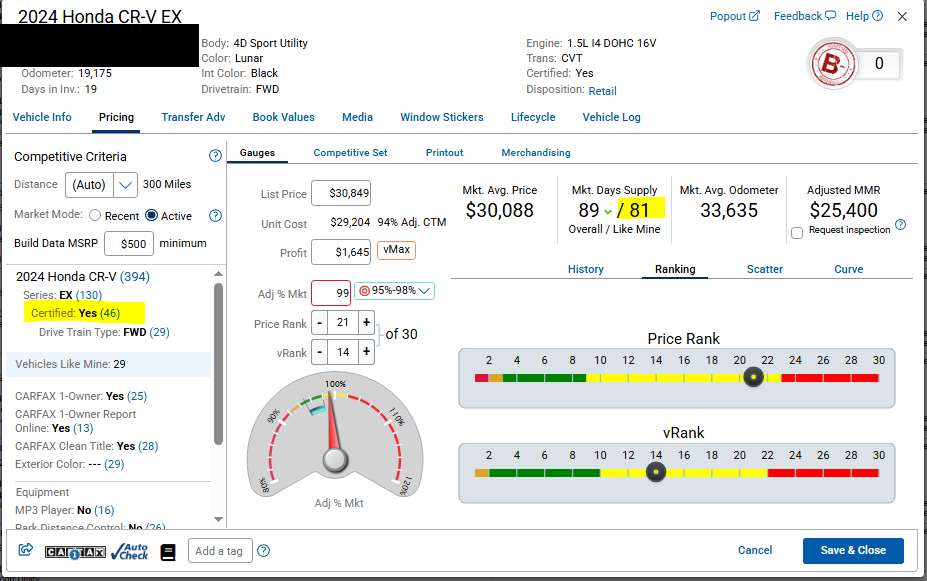
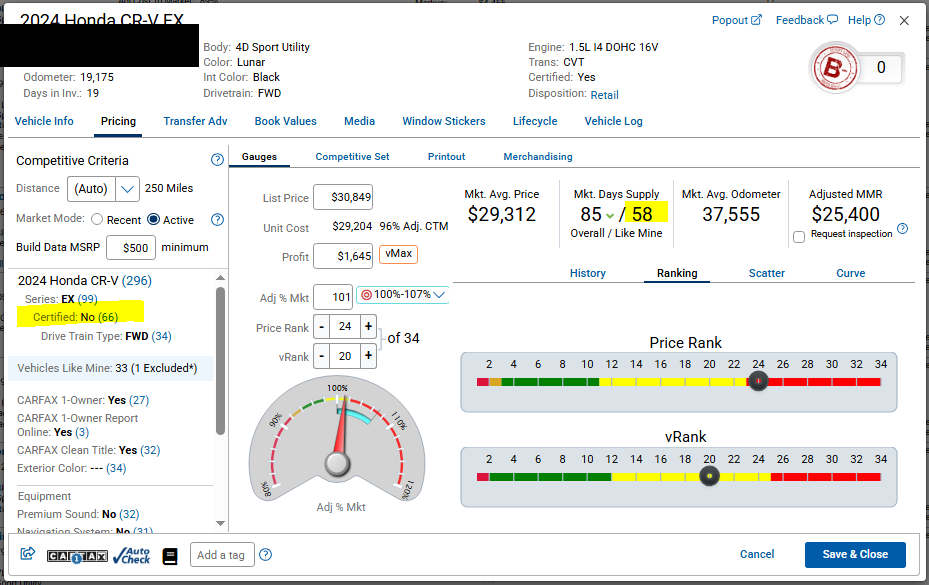
2024 Honda CR-V EX: a higher CPO asking price did not establish a payback
CPO COMP SET · 300-MILE RADIUS
NON-CPO COMP SET · 250-MILE RADIUS
| Competitive set | Like-mine days’ supply | Average listing price | Search radius |
|---|---|---|---|
| CPO | 81 days | $30,088 | 300 miles |
| Non-CPO | 58 days | $29,312 | 250 miles |
The certified set showed a $776 higher average asking price, but it also showed 23 more days of like-mine supply. The two search radii differed because the distance needed to find enough relevant vehicles can differ by set. The radius is part of the market context; it should be recorded and widened only as needed to build a sound comparison.
Here, the asking-price difference alone does not show that certification will pay for itself. Unless the store’s realized CPO premium, program benefits, and turn results cover the added cost, the higher advertised price is not enough.
Use 15–20 relevant comps before drawing a strong conclusion
A small competitive set can make one or two listings look like a market trend. I recommend a minimum of 15–20 relevant comparables for a useful read. Start with the closest true matches. Expand the radius only as far as needed to reach that range, and record the distance for both the CPO and non-CPO views.
Keep the comparison focused on the same year, make, model, trim, mileage range, condition, and buyer price band wherever the data allows. If the sets require different radii, say so. Do not hide the difference or treat radius as a quality failure by itself.
The PPO CPO Value Test
- Build a credible set. Find at least 15–20 relevant CPO and non-CPO comps. Record the filters, comp count, and radius required for each.
- Compare the market response. Review like-mine days’ supply and current asking prices. A premium matters more when the CPO set is also scarce; price alone can mislead.
- Calculate the full added cost. Include certification fees and any required inspection, repair, or reconditioning work. Use your store’s actual program costs.
- Check realized results. Compare actual selling price, front gross, days to sale, and other measurable program benefits. Asking prices are not completed transactions.
- Make the call before acquisition. Certify when the market evidence and your store’s results support the added investment. If they do not, buy and merchandise the vehicle as non-CPO.
Certification is a decision, not a default
The Prologue view gave a reason to take the CPO opportunity seriously: a tighter like-mine supply and a modest difference in average listing price. The CR-V view was a warning against assuming the certified label automatically creates value: the certified set was slower, and the higher asking price still had to cover the program cost.
Those are different answers because the vehicles and their competitive sets are different. That is the point. The useful question is not whether CPO is good or bad. It is whether certification improves this vehicle’s market position enough to earn its cost.
Want a repeatable process for making acquisition, pricing, and inventory decisions? Explore The Used-Car Inventory Operating System.
Market figures are reported by Cox Automotive. Vehicle-level comparisons are from the vAuto competitive-set views provided for this analysis. PPO’s conclusions are operator interpretation of those specific examples; they are not a universal claim about CPO performance.