
A $3,000 auction-to-retail spread can disappear one ordinary problem at a time.
A little too much mileage. A weaker trim. Two recon assumptions. Transportation and auction fees. A vehicle that takes longer than expected to reach the frontline.
None of those issues necessarily kills the acquisition. The problem is allowing several manageable issues to accumulate without changing the bid.
That is inventory friction.
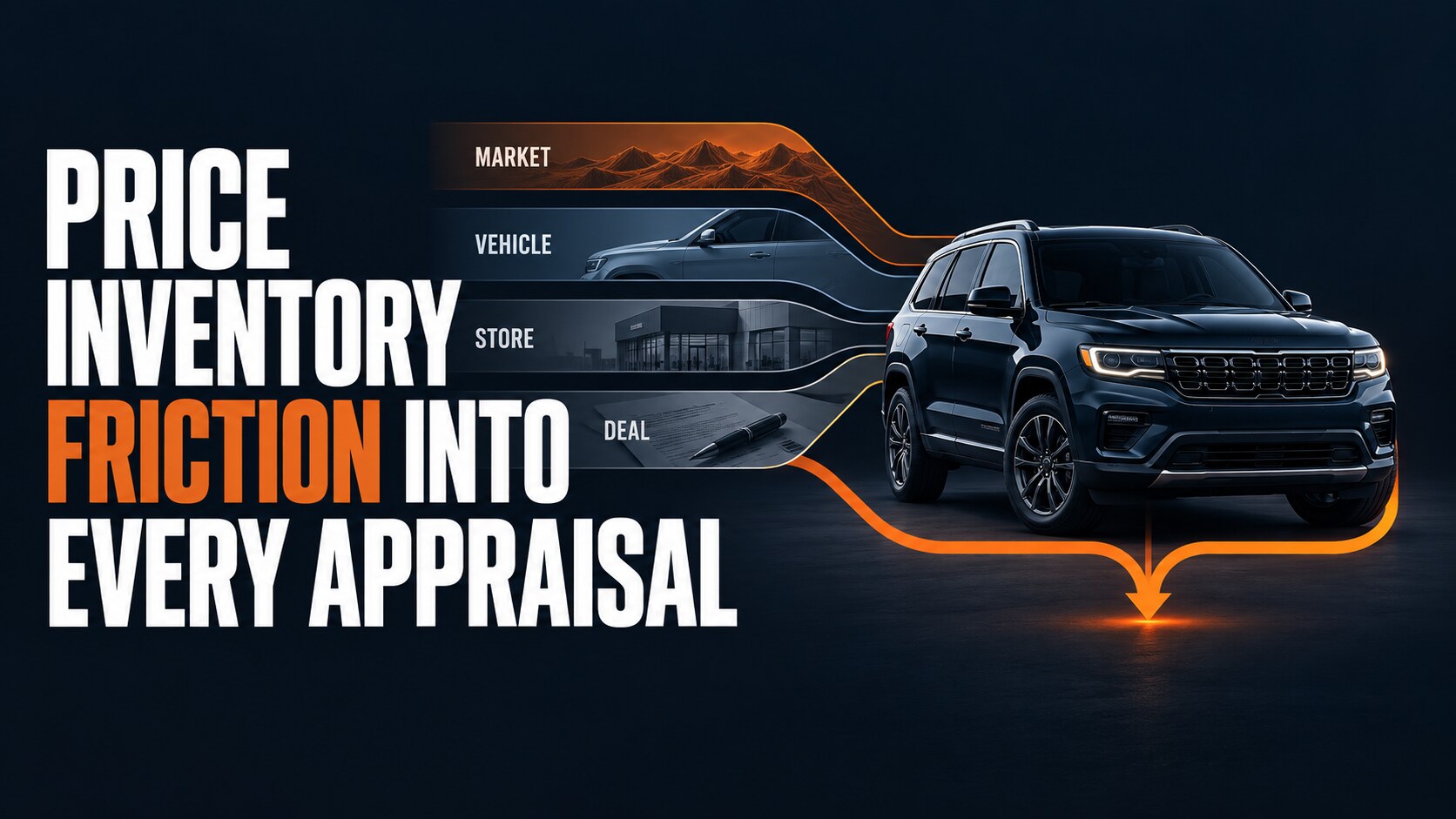
Most appraisals account for the obvious costs. The stronger appraisal process also identifies the market, vehicle, store and deal risks that determine whether projected spread ever becomes usable gross.
The current wholesale market is exposing unpriced friction
Black Book reported that wholesale values declined 0.69% during the week ending September 19, compared with an average decline of 0.17% during the same week from 2017 through 2019. Auction conversion fell three points to 58%.
The important signal was not simply that values declined. Pricing became more dispersed. Buyers continued concentrating bids on retail-ready vehicles while discounting units with average or elevated mileage, lower-content trims, condition shortcomings and less desirable configurations.
Vehicles carrying several of those characteristics were frequently trading below clean-book expectations and moving toward average-to-rough valuation ranges.
Cox Automotive's mid-September Manheim report showed the same selectivity from another direction. MMR retention averaged 99.6%, while auction conversion fell to 55.8%.
Those numbers can coexist. The vehicles that sold were still bringing close to MMR. A larger share of the vehicles offered did not sell.
PPO interpretation: Transaction prices show what cleared the lane. Conversion and bid depth show what buyers refused to own. A useful appraisal needs both.
This builds on the market pattern described in The Wholesale Market Is No Longer Rewarding “Close Enough.” The next operating question is how to quantify that penalty before the vehicle becomes inventory.
What is inventory friction in a used-car appraisal?
Inventory friction is any market, vehicle, store or deal characteristic that makes a unit harder or more expensive to acquire, prepare, finance, merchandise, retail or exit.
Some friction is visible immediately: accident history, worn tires, high mileage or a weak condition report.
Other friction is easier to miss:
- The segment is depreciating faster than the guidebook has recognized.
- The trim lacks the equipment local shoppers repeatedly choose.
- The store regularly waits two weeks for parts on that model.
- The expected buyer cannot finance the projected retail price cleanly.
- The vehicle fits the broad market but has performed poorly at this store.
- The exit market is shallow if the retail thesis fails.
Friction does not automatically mean pass. It means the acquisition needs one of four responses:
- Adjust the bid.
- Change the retail plan.
- Define an earlier exit.
- Pass.
The PPO Inventory Friction Stack
Evaluate every meaningful acquisition through four layers. The goal is not to create another complicated score. It is to prevent an attractive spread from hiding several unpriced assumptions.
1. Market friction
Market friction measures how much support exists for the exact vehicle—not merely its broad segment.
Review:
- Local market days supply and true substitute count
- Segment and age-band depreciation
- Auction conversion and bid depth
- Price-to-market position at the expected retail price
- Replacement difficulty
- Demand inside the relevant price and payment band
A declining market does not make every vehicle equally cheaper. The best examples may continue producing competitive bidding while interchangeable or flawed inventory absorbs most of the discount.
This is why Scarcity Before Price still belongs at the beginning of the acquisition decision. A lower price is useful only when the vehicle retains a reason to win after it reaches the lot.
2. Vehicle friction
Vehicle friction includes the VIN-specific characteristics the next buyer will experience:
- Mileage and mileage band
- Trim, drivetrain, color and equipment
- Accident, rental, fleet or ownership history
- Mechanical and cosmetic condition
- Tires, brakes, keys, glass and warning lights
- Certification eligibility
- EV battery condition when applicable
The mistake is evaluating each issue in isolation. A vehicle can remain “average condition” on paper while carrying an above-average combination of mileage, equipment, history and recon exposure.
Do not deduct the same flaw twice. Do recognize when multiple independent forms of friction change the complete retail proposition.
For used EVs, the same discipline becomes even more important because battery evidence and charging capability affect appraisal confidence and merchandising. The Used-EV Appraisal Consistency Guide shows how a category-specific scorecard can standardize those decisions across a dealer group.
3. Store friction
A vehicle can be good in the market and still be wrong for a particular operation.
Store friction includes:
- Expected days from acquisition to frontline
- Parts availability and vendor capacity
- Estimated-versus-actual recon accuracy
- Past turn and gross on comparable units
- Lead and close-rate performance
- Sales-team confidence with the product
- The store's ability to merchandise the vehicle correctly
A predictable store constraint belongs in the appraisal. It should not become a surprise after the purchase.
If a model repeatedly waits 15 days for parts, that delay has economic value. It consumes carrying time, postpones demand exposure and shortens the remaining window before the first pricing decision.
The operating lesson from cutting dealership recon time is straightforward: time to frontline is not merely a service-department metric. It changes what the store can afford to pay.
4. Deal friction
Deal friction asks whether the intended customer can purchase and own the vehicle through a sustainable structure.
Review:
- Expected payment at realistic term and rate
- Loan-to-value and lender advance
- Cash-down requirement
- Negative-equity tolerance
- Age and mileage restrictions
- Insurance exposure
- Vehicle-switch rate on similar inventory
- Funded-deal conversion
A vehicle is not financeable merely because a lender eventually approves it. The inventory should create a workable deal without depending on the longest term, thinnest equity position and highest cash requirement available.
How to convert friction into a max bid
Begin with the expected retail outcome—not the asking prices you hope the market will support.
Then subtract:
- Market-risk allowance: likely depreciation, competitive pressure and exit exposure.
- Total added cost: auction fees, transportation, recon, pack and certification.
- Store-friction allowance: predictable delay, parts exposure or execution disadvantage.
- Deal-friction allowance: financeability or payment-position risk that may force a lower retail outcome.
- Required gross: the return necessary to justify the capital and risk.
The result is the maximum acquisition value supported by the complete retail thesis.
A simplified example
Assume the expected retail outcome is $32,000.
- Expected retail outcome: $32,000
- Market-risk allowance: –$1,200
- Fees, transportation and recon: –$2,300
- Store-friction allowance: –$800
- Deal-friction allowance: –$500
- Required front gross: –$2,500
Maximum supported acquisition value: $24,700.
The point is not that every friction estimate will be perfectly precise. The point is that the appraisal should expose the assumptions before the bid—not after the first markdown.
Use allowance bands instead of false precision
Not every dealership has enough history to calculate a statistically perfect adjustment for every issue. That should not prevent the store from becoming more consistent.
Create simple allowance bands:
- Low friction: normal execution; no additional adjustment.
- Moderate friction: documented allowance or lower max bid.
- High friction: materially different retail plan, earlier exit or pass.
Then compare the allowance with the actual result. Over time, estimated-versus-actual recon, days to frontline, gross and turn will improve the bands.
This is Signals Before Confirmation. The store acts when several risks begin stacking—not when age finally confirms that the acquisition was wrong.
A five-minute friction review for the appraisal meeting
Before approving a meaningful acquisition, require the appraiser to answer:
- What is the strongest evidence supporting the expected retail outcome?
- Which market, vehicle, store and deal frictions are present?
- Where are those risks reflected in the max bid?
- How many assumptions must go right for the required gross to survive?
- What is the review date and exit trigger if the thesis fails?
If the vehicle works only when every assumption is favorable, the spread is not protection. It is hope built into the appraisal.
Common mistakes when pricing inventory friction
Using clean book as an entitlement
Clean book is a reference point, not a promise. The complete vehicle must earn that valuation through condition, configuration, demand and retail readiness.
Counting only visible recon
Tires and brakes are easy to estimate. Parts delays, missed equipment, weak payment position and shallow exit demand can cost just as much.
Using sold units without studying no-sales
Sold comparables reveal transaction price. No-sales, repeated exposure and bid depth reveal selectivity.
Assuming a market discount creates gross
Replacement cost can fall before retail asking prices react. As explained in Wholesale Prices Fell. Retail Prices Rose., that gap can create temporary opportunity. It can also disappear as competitors replace inventory at lower costs.
Planning to solve every problem after acquisition
Better merchandising, recon and pricing can improve a good buy. They cannot reliably repair an acquisition whose economics required perfection from the start.
The operating rule
Count the frictions before you count the spread.
The current wholesale market is rewarding retail-ready inventory and discounting vehicles that carry several ordinary risks at once.
The operator advantage is not avoiding every imperfect vehicle. It is knowing exactly what the imperfection costs, where it belongs in the appraisal and when the combined burden requires a different decision.
Build the appraisal into a complete operating system
The Used-Car Inventory Operating System connects acquisition rules, recon accountability, pricing cadence and exit decisions so the team is not solving the same predictable problems after every purchase.
Frequently asked questions
What is inventory friction?
Inventory friction is any market, vehicle, store or deal characteristic that increases the cost, time or difficulty required to acquire, prepare, finance, retail or exit a used vehicle.
Should every form of friction reduce the bid?
No. Some risks can be addressed through a different retail plan or earlier exit. The requirement is that every material friction receives an explicit response rather than becoming an unpriced assumption.
How do you avoid double-counting condition deductions?
Separate direct costs from risk allowances. Deduct a known repair once. Use a separate allowance only when an independent risk remains, such as extended parts delay, weaker demand or reduced exit value.
Which friction should a dealership measure first?
Start with the category producing the largest repeated variance between the appraisal and the final result. For many stores, that is estimated-versus-actual recon or days from acquisition to frontline.