

Why Price Adjustments Fail Outside the Demand Window
Most dealers still price inventory like demand behaves on a curve.
Lower the price a little, demand should improve a little.
Lower it again, engagement should rise again.
That logic feels reasonable.
But it is not what many operators are seeing right now.
What they are seeing is this:
- One unit gets no traction
- A similar unit gets immediate engagement
- Small price changes do nothing
- The market feels inconsistent
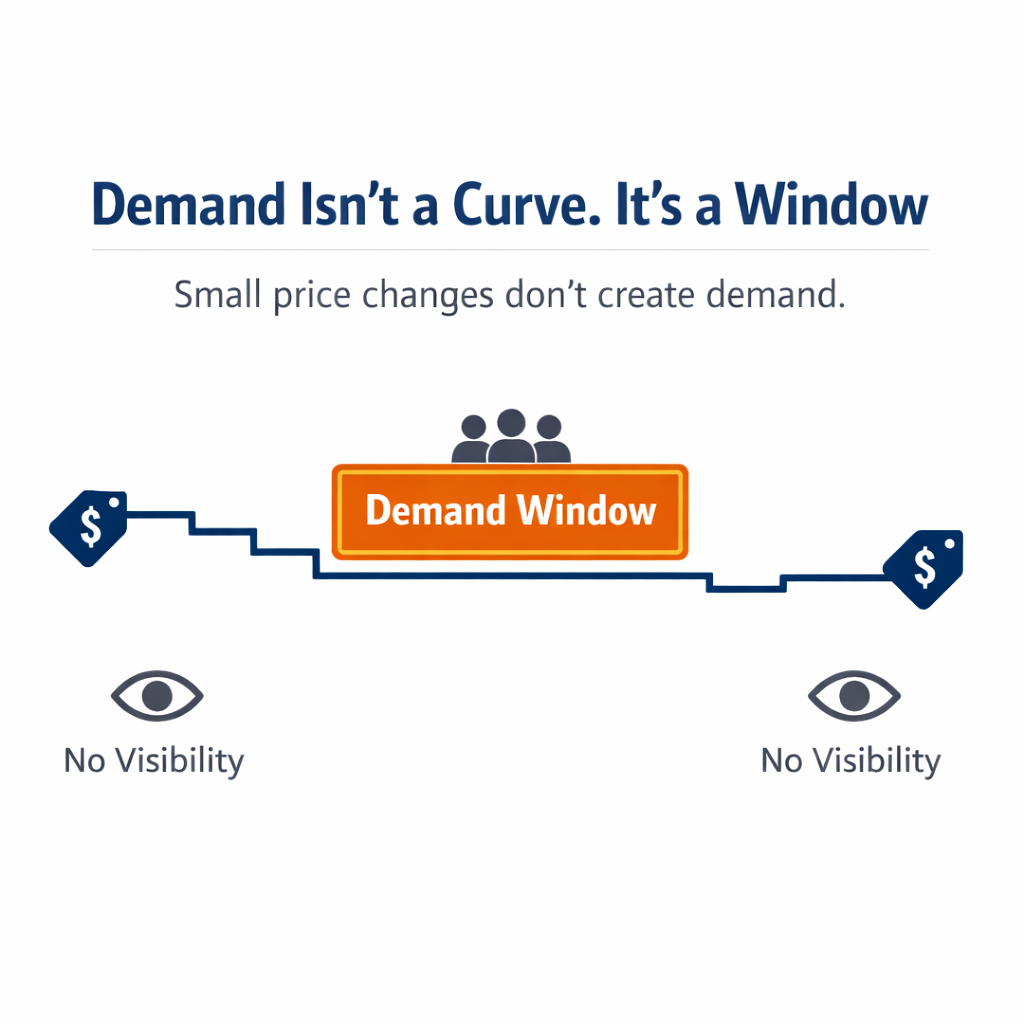
That is because demand is not acting like a curve.
It is acting like a window.
Demand Is Not a Curve. It’s a Window.
In a normal curve mindset, every pricing move is supposed to create a proportional change in demand.
That is not how this market feels on the ground.
Right now, units tend to behave in one of two ways:
- They are aligned and visible to the buyer
- Or they are misaligned and mostly ignored
There is often very little in between.
That is why pricing adjustments can feel useless. The unit is not slowly moving toward demand. It is either inside the demand window or it is outside of it.
And if it is outside, small pricing moves usually do not matter.
Why Small Price Changes Fail
This is where stores lose time.
A unit sits, so the price gets adjusted by $300.
Still nothing.
Then another $400.
Still nothing.
Then maybe another $500.
Now, everyone starts saying the market is soft.
But in many cases, price was not the core issue.
The unit was simply outside the buyer’s demand window.
That means the problem is not that the market rejected the latest price adjustment.
The problem is that the vehicle was never truly in the consideration set to begin with.
Small price changes do not create demand.
They only help when demand already exists, and the unit is close enough to the window for the buyer to respond.
Misalignment Is What Looks Like an “Inconsistent Market.”
This is why the used car market feels confusing to so many operators right now.
They see one car sitting for weeks.
Then they see another seemingly similar car move quickly.
Same segment. Similar mileage. Similar price band.
Different result.
That gets interpreted as randomness.
It is not random.
It is misalignment.
What looks like an inconsistent market is often just a market separating aligned inventory from misaligned inventory faster and more aggressively than before.
That is a big part of the larger thesis behind Used Cars Won’t Crash.
The market is not broadly “normalizing.” It is becoming more selective. And that selectivity is widening the gap between units that fit demand and units that do not.
Same Price Band Does Not Mean Same Demand
This is one of the biggest mistakes operators can make right now.
Two units can live in the same price band and still have very different demand profiles.
Why?
Because buyers are not evaluating price in isolation.
They are evaluating the full offer:
- Trim and equipment
- Payment fit
- Condition
- Story and presentation
- Perceived ownership risk
- Confidence in the listing itself
So when a dealer says, “But we’re priced right with the market,” that may be technically true and strategically wrong at the same time.
The same price band does not mean the same demand.
That is why two units that look comparable in a pricing tool can perform completely differently in the real market.
The Real Issue Is Misalignment, Not Price
If a unit is misaligned, pricing becomes a weak lever.
Not because pricing never matters.
It does.
But price works best when the unit is already close to what the buyer wants.
When alignment is off, price cuts mostly delay the real conversation.
That conversation is:
Does this unit actually fit today’s demand?
If the answer is no, then time will not fix it.
Small discounts will not fix it.
Repeated markdowns will not fix it.
The store is not facing a pricing problem first.
It is facing an alignment problem first.
Get the PPO Brief Every Monday
The Profitable Pre-Owned Brief delivers weekly used-car market intelligence for operators who want sharper signals and better inventory decisions.
Subscribe to the PPO BriefThis Shows Up Fastest in EV Inventory
This is one reason EV pricing frustrates so many dealers.
They assume a unit is close enough and start making incremental price changes.
But EV demand windows are often tighter, and buyers are usually less flexible.
That means misalignment gets exposed faster.
The unit may look competitively priced and still fail because the issue is not the number. The issue is that the vehicle is outside the buyer’s trust, use-case, or payment comfort zone.
I break that down in more detail in the Used EV Playbook.
What Operators Should Take From This
If a unit is not responding, do not assume the next small pricing move will solve it.
Start by asking a different question.
Not “What should we price it at?”
Ask:
Is this unit actually aligned with demand right now?
That changes the conversation.
Because once you understand demand as a window instead of a curve, the market stops looking inconsistent.
It starts making sense.
Some units are simply inside the window.
Others are not.
And until operators address that, price adjustments will keep failing for reasons that have nothing to do with price itself.
Final Thought
A lot of stores think they are managing pricing pressure.
What they are really managing is market separation.
Aligned inventory still moves.
Misaligned inventory gets exposed.
That is the real issue.
And that is why so many small price changes lead nowhere.