
Used-car inventory increased in June. But the inventory most payment-sensitive buyers need remains scarce.
The headline says the used-car market has more inventory.
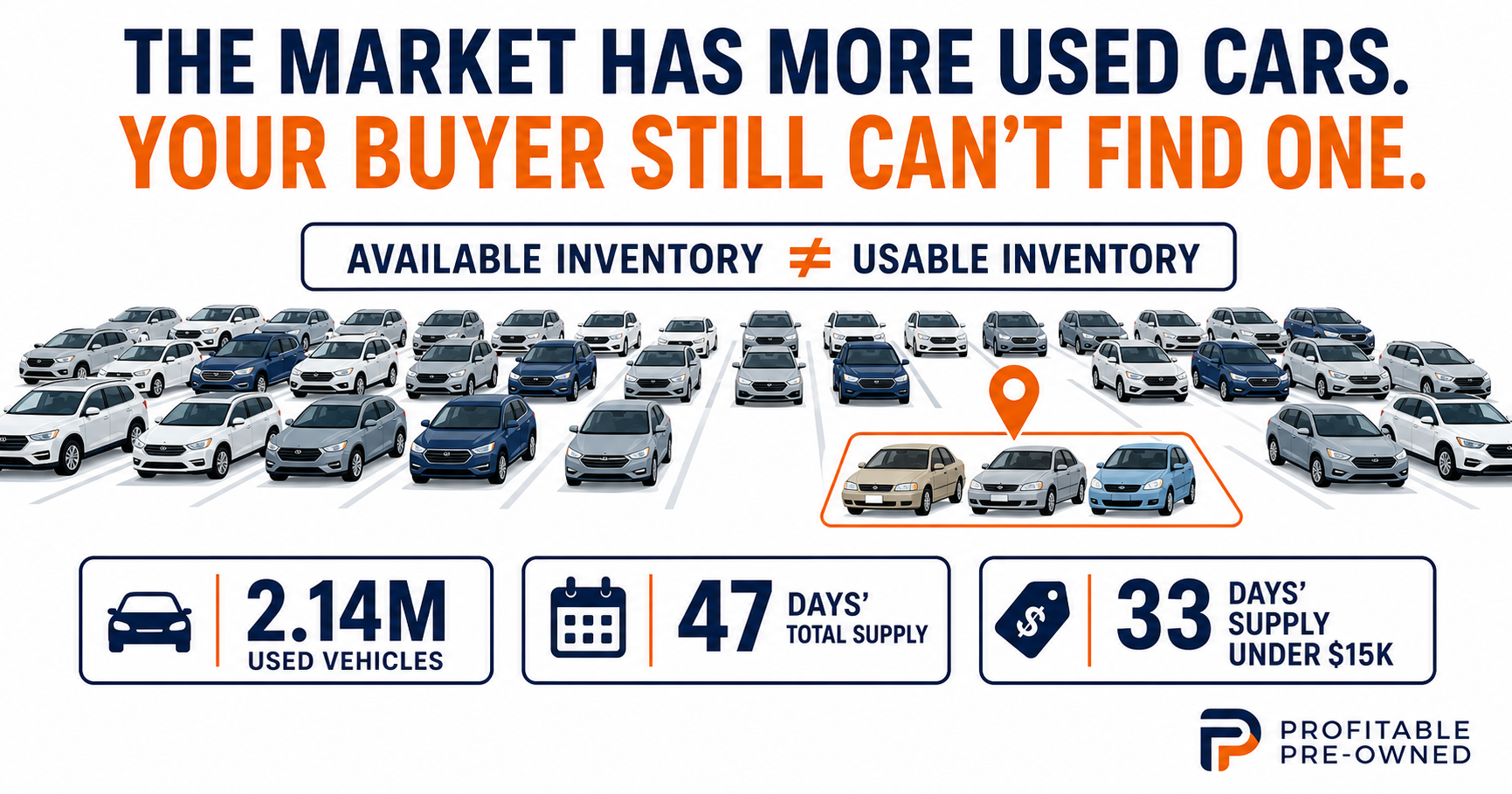
Total used inventory increased to 2.14 million vehicles, while days’ supply rose to 47.
That sounds like an improvement.
But vehicles priced below $15,000 carried only 33 days’ supply.
At the same time, the average used listing price reached $27,027, up 6% from a year earlier.
That creates the real operating story:
The used-car market does not have a simple inventory shortage. It has a usable-inventory shortage.
The market may have more vehicles overall, but much of that inventory does not fit the payment capacity, credit profile, ownership-cost tolerance, or transportation need of the customer actually shopping.
A dealership can have a full lot and still be understocked.
PPO Takeaway:
Stop asking only how many vehicles you own. Start asking how many your actual customer can buy, finance, trust, and afford to own.
The Difference Between Available and Usable Inventory
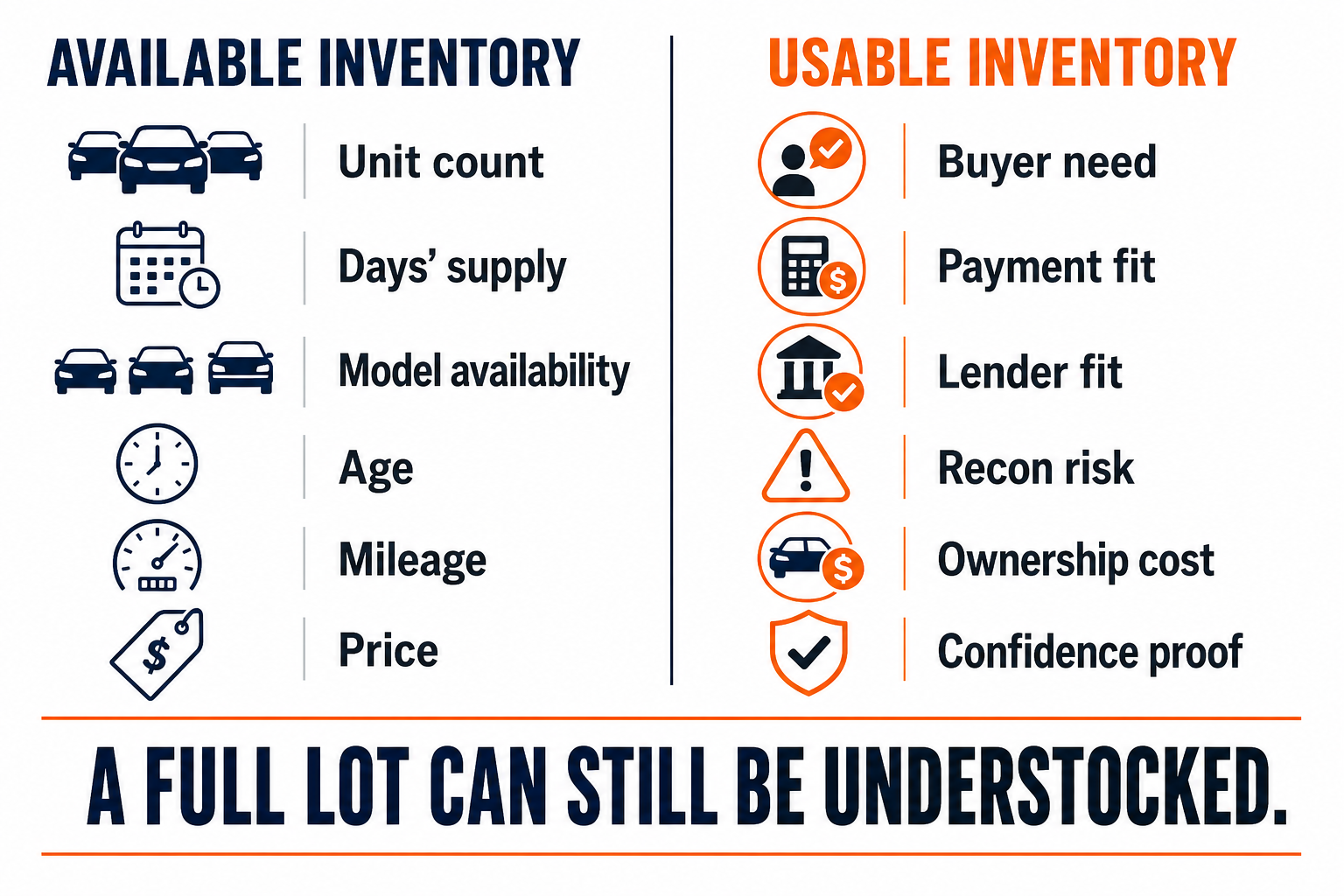
Available inventory is easy to measure.
It includes:
- Total units
- Days’ supply
- Model availability
- Age
- Mileage
- Price
Usable inventory is different.
A usable vehicle fits the customer’s:
- Transportation need
- Price range
- Payment capacity
- Likely lender approval
- Mileage and age restrictions
- Ownership-cost tolerance
- Condition expectations
- Confidence requirements
A vehicle can be available, attractive, and competitively priced while remaining difficult for the store’s actual customer to purchase.
A full lot does not automatically mean a well-stocked lot.
If too many vehicles sit outside the buyer’s usable price, payment, lender, and ownership window, the store is functionally understocked.
Why 47 Days’ Supply Can Be Misleading
Overall used-vehicle days’ supply reached 47 in June.
But the under-$15,000 category carried only 33 days’ supply.
That 14-day difference reveals a significant segmentation problem.
Broad market inventory improved partly because sales slowed and because more inventory exists in higher price bands.
That does not solve the affordability challenge facing the buyer shopping at the lower end of the market.
An operator looking only at total inventory may conclude that sourcing conditions are improving.
A buyer shopping below $15,000 may experience the opposite.
Both views can be true.
The customer does not shop the entire market. They shop inside a narrow usable window.
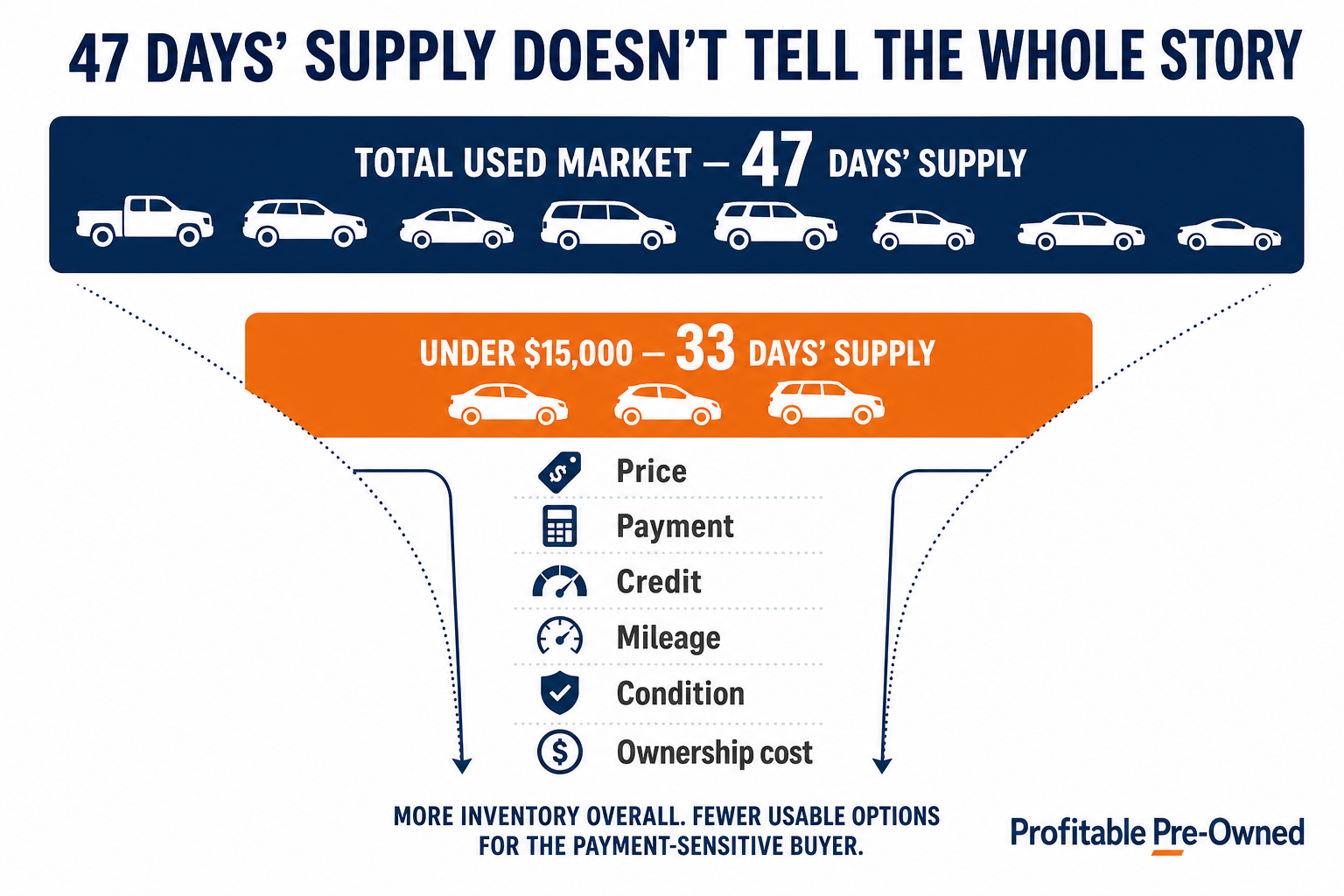
That window is shaped by:
- Price
- Payment
- Credit
- Cash down
- Mileage
- Vehicle age
- Condition
- Expected ownership cost
The Necessity Buyer Is Shaping the Market
Recent Cox Automotive research developed in consultation with NIADA found that 79% of independent-dealership buyers say they need a vehicle rather than simply want one.
The research also found:
- 77% of buyers purchasing vehicles between 11 and 20 years old have household income below $75,000
- Buyers spend an average of 16.5 hours researching online
- 77% use third-party listing sites
- Only 21% say they would return to the same dealership
This is not an aspirational customer casually comparing upgrades.
It is often a buyer trying to solve a real transportation problem while managing financial pressure and constrained credit.
That customer evaluates inventory differently.
Price matters, but so do:
- Expected monthly payment
- Cash required at delivery
- Service history
- Tire and brake condition
- Warranty coverage
- Fuel and insurance expense
- Lender acceptance
- The likelihood of an immediate repair
For the necessity buyer, vehicle selection is inseparable from transaction structure and ownership risk.
Affordable Inventory Is Available—but Operationally Difficult
Manheim reports that it averages approximately 150,000 wholesale transactions per month below $10,000.
More than half of all vehicles sold through Manheim in 2025 were priced below $20,000.
Most sub-$10,000 vehicles are between 7 and 15 years old and represent practical transportation from high-volume brands.
That creates sourcing opportunity.
It also creates operational complexity.
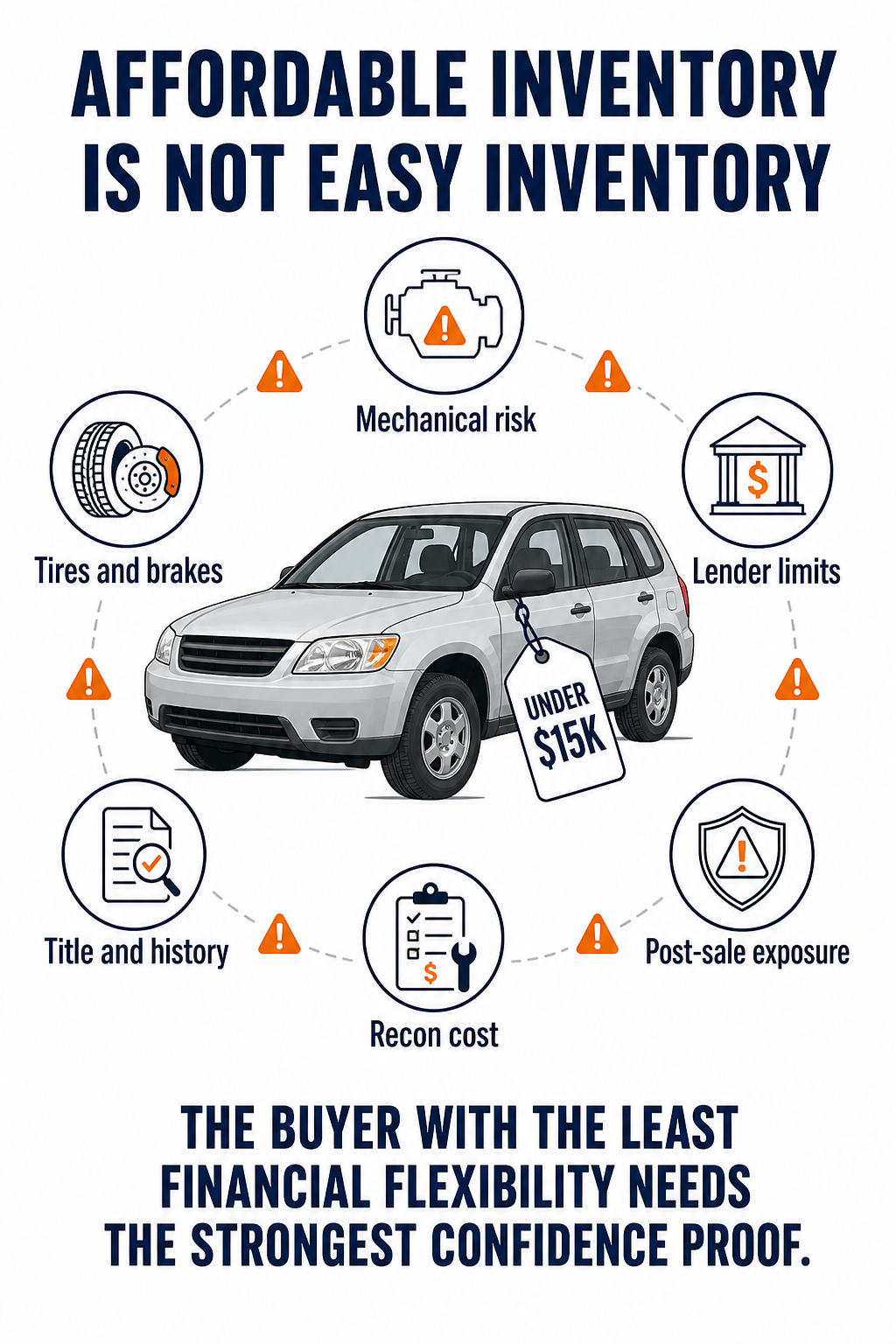
An affordable acquisition can quickly become an expensive retail problem when the vehicle carries:
- Unresolved mechanical needs
- Significant tire or brake expense
- Lender mileage restrictions
- Condition issues
- Title or history concerns
- High transportation cost
- Limited warranty options
- Post-sale risk
Affordable does not mean easy.
The buyer with the least financial flexibility often needs the strongest condition and ownership proof.
The lower-priced vehicle cannot be managed with lower standards.
In many cases, it requires stronger standards because the buyer has less financial capacity to absorb an ownership surprise.
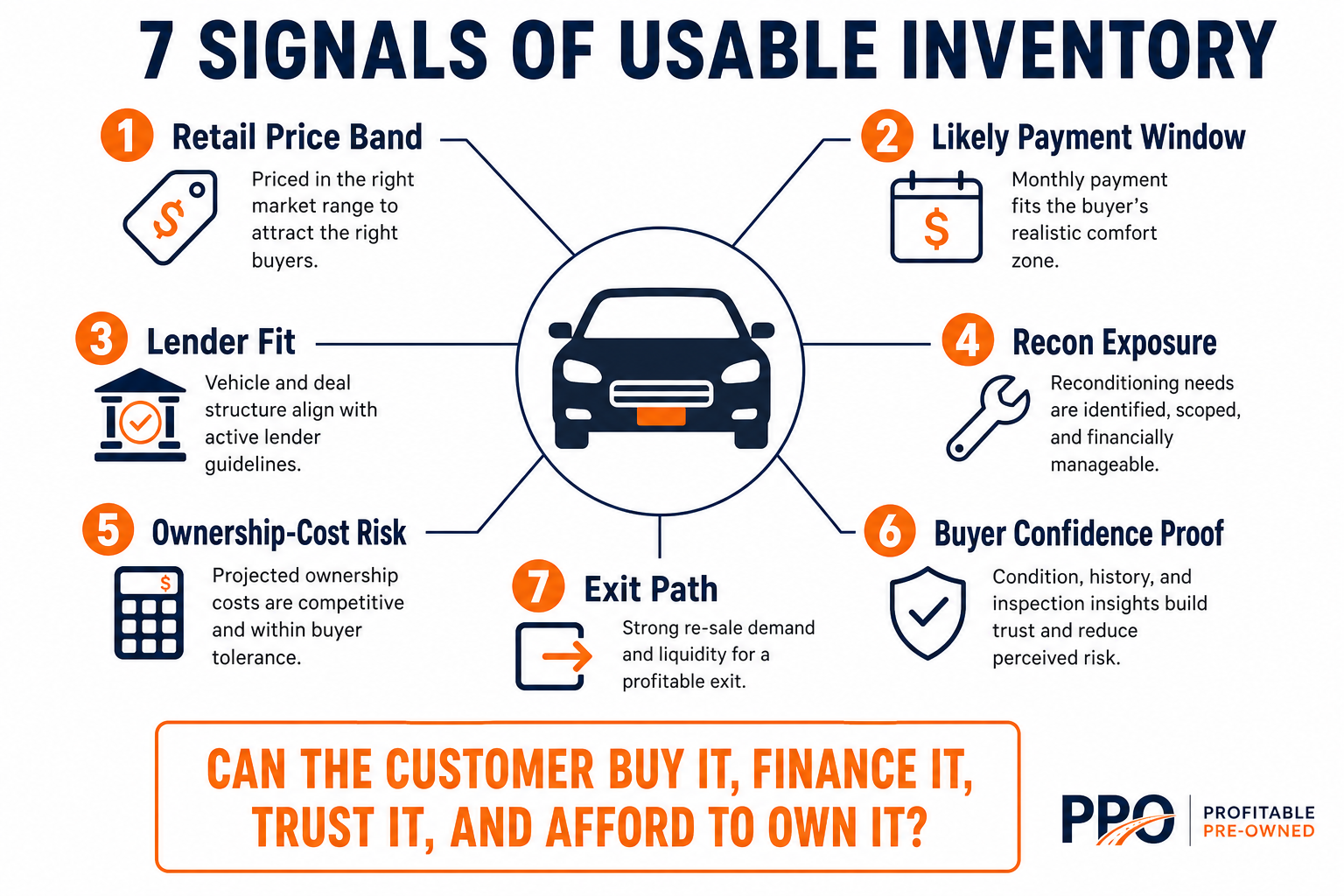
Seven Ways to Measure Usable Inventory
1. Retail Price Band
Track how many vehicles sit inside the actual price bands your customers shop.
Do not rely only on the store’s average retail price.
2. Likely Payment Window
Estimate the payment range the vehicle is likely to produce under realistic terms.
Do not use an artificially long term or unusually high cash down to make a unit appear affordable.
3. Lender Fit
Review age, mileage, advance, book value, loan-to-value, and vehicle eligibility across the lenders the store actually uses.
4. Recon Exposure
Lower-priced vehicles often require more diagnostic and mechanical discipline.
Understand the full recon risk before acquisition, not after the vehicle reaches the shop.
5. Ownership-Cost Risk
Fuel use, insurance cost, tires, maintenance, repair exposure, charging, and warranty all influence whether a vehicle fits the buyer.
6. Buyer Confidence Proof
The listing should clearly show inspection, service, condition, history, recon, and known wear.
The customer should not have to ask the salesperson to discover the vehicle’s story.
7. Exit Path
Affordable inventory can still become aged inventory.
Every acquisition needs a defined retail window and a realistic exit path.
Buying by Model Is Not Enough
Traditional stocking plans often begin with model-level sales history.
That approach misses critical differences.
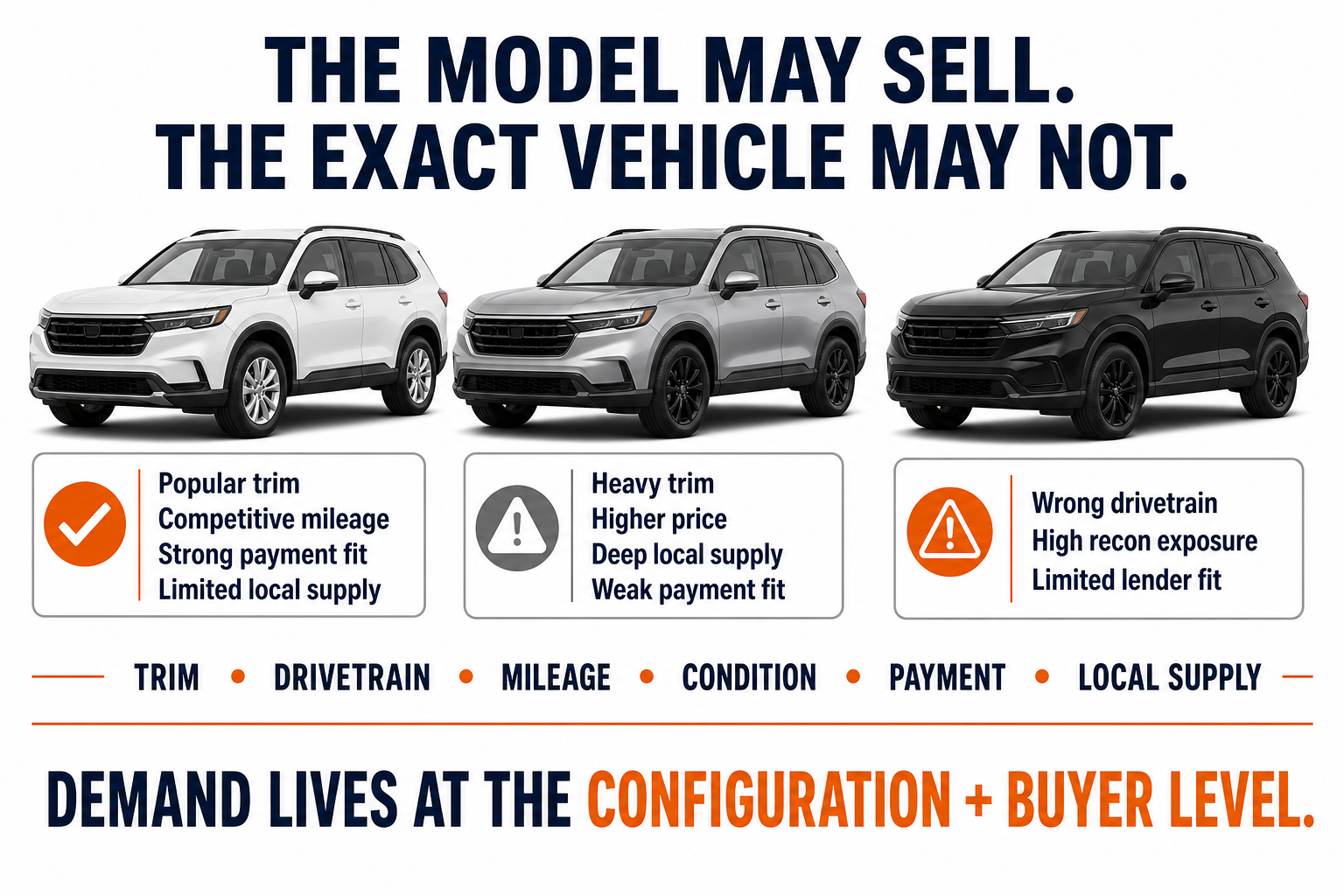
Two versions of the same model can produce very different outcomes based on:
- Trim
- Drivetrain
- Mileage
- Equipment
- Condition
- Price
- Payment
- History
- Ownership cost
- Local supply
Demand does not live only at the model level.
It lives at the configuration and buyer level.
The question is not simply whether the market sells the model.
The question is whether this exact unit fits a real buyer inside the store’s operating environment.
A New Operator Question
Inventory planning should no longer begin and end with:
How many used vehicles do we need?
A stronger question is:
How many vehicles do we need inside each usable buyer window?
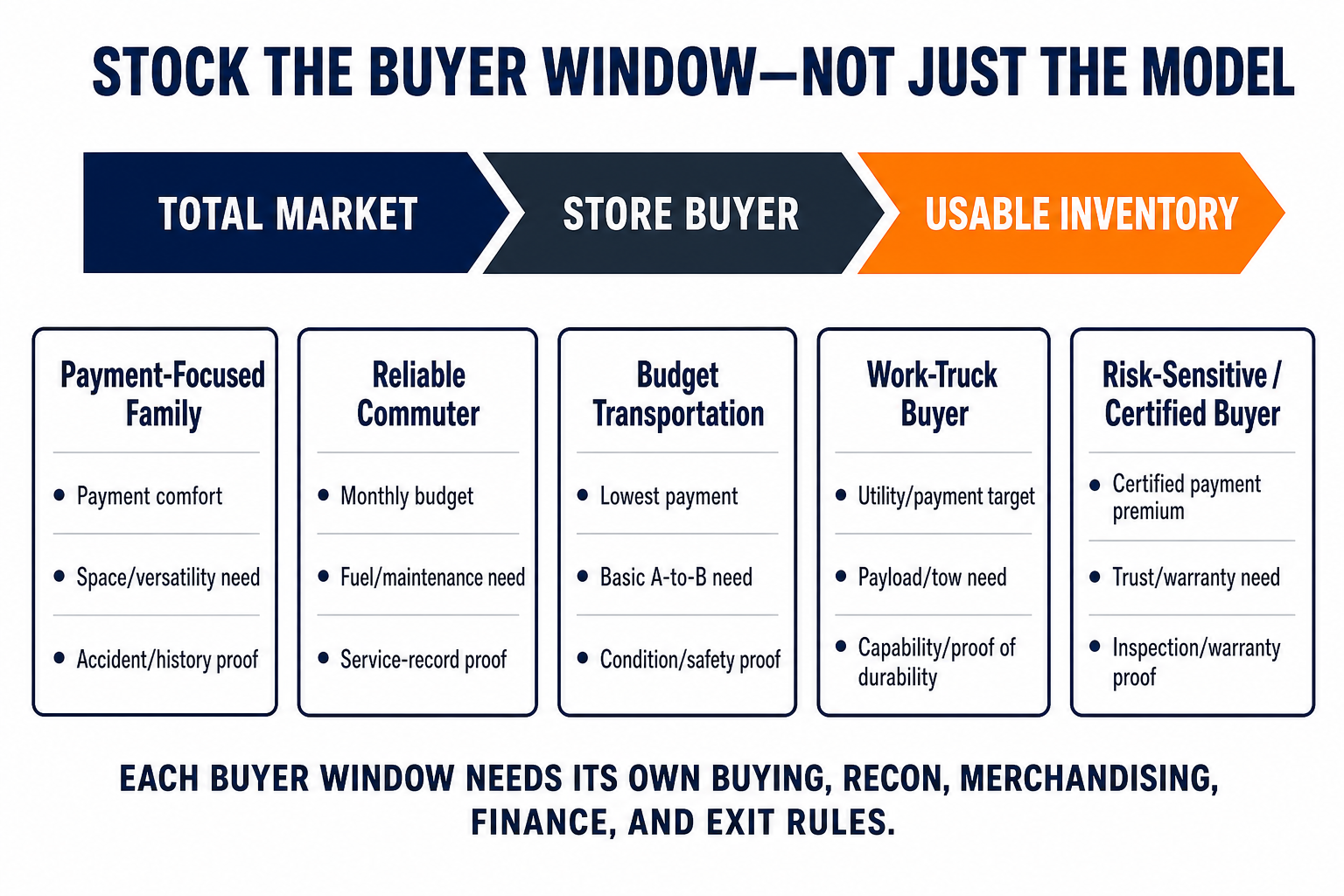
That may include:
- Payment-focused family inventory
- Reliable commuter inventory
- Sub-$15,000 budget transportation
- Work-truck inventory
- Low-mileage condition inventory
- Used EVs with transparent battery and charging information
- Certified inventory for risk-sensitive buyers
Each category requires different acquisition, recon, merchandising, financing, and pricing rules.
The PPO Operator Response
1. Separate Inventory by Buyer Constraint
Do not rely only on brand, model, age, or total days’ supply.
Classify inventory by price band, payment window, lender fit, buyer type, and ownership-cost risk.
2. Protect Affordable Inventory From Recon Drift
Measure recon time and expense as aggressively as acquisition cost.
Every unnecessary day and every avoidable repair can erase the payment advantage that made the vehicle attractive.
3. Review Lender Fit Before Acquisition
Do not discover after the vehicle reaches the lot that its age, mileage, advance, or book position limits the store’s lender coverage.
4. Merchandise for the Risk the Buyer Needs Reduced
Use inspection, service, condition, recon, ownership history, and warranty information to build confidence before the customer reaches the desk.
5. Give Every Unit a Defined Retail Window
Affordable inventory can still become aged inventory.
Every acquisition should include an early decision point and a realistic exit path.
The market has more inventory.
That does not mean your customer has more usable choices.
PPO Takeaway
The used-car market does not have one inventory condition.
It has multiple inventory conditions separated by price, payment, age, mileage, lender fit, and buyer need.
Overall supply can rise while affordable supply remains tight.
A dealership can own more vehicles while creating fewer usable transactions.
That is why operators should stop measuring inventory depth only by units and days’ supply.
Measure how much of the inventory can be bought, financed, trusted, and owned by the customer the store actually serves.
Marketability creates interest.
Usable inventory creates completed transactions.
Subscribe to the PPO BriefBottom Line
The used-car market has more inventory.
But the customer shopping inside the most constrained price and payment bands still faces limited choices.
The dealer response is operational:
- Measure inventory by buyer constraint
- Review financeability before acquisition
- Control recon exposure
- Build confidence through condition and ownership proof
- Set a defined retail window and exit path
Your lot can be full and still be understocked.
The real question is how much of your inventory your actual customer can complete a transaction on.
Source: Cox Automotive, “Used-Vehicle Inventory, June 2026.”
Source: Manheim, “Manheim Highlights Opportunity in Sub-$10,000 Inventory.”
Source: Cox Automotive, “Independent Dealership Buyers Are Driven by Necessity, Not Aspiration.”