

.png)
Used EV Attack Mode? Watch the New EV Payment Gap First.
For the last few weeks, the industry has been debating:
- Battery disclosures
- Lease-return waves
- MMR proximity to retail
- When to flip into “attack mode” on used EVs
I’ve said clearly: it’s not time yet.
But here’s the part that gets missed in operator conversations:
The next used EV margin squeeze may not start at the auction.
It may start on the new-car side — with incentives that quietly compress the payment gap.
The Incentive Creep Nobody Is Debating
There usually isn’t a headline when this starts. It shows up in program sheets, not press releases.
Across new EV programs, we’re seeing subtle pressure in the same direction:
- Subvented APR creeping lower
- Dealer cash stacking in volume trims
- Captives stretching terms to protect “payment optics.”
- Payment-first marketing returning (instead of value-first)
Individually? Small moves.
Collectively? Payment compression — and payment compression is what shrinks used EV pricing elasticity before most teams notice.
This Cycle Won’t Look Like 2023
In 2023, wholesale broke first, and retail followed.
This cycle can flip the order:
Retail elasticity can compress first, while wholesale still looks “stable.”
Here’s how the trap forms:
- Used EV acquisition stays tight
- MMR stays firm
- Spread stays narrow
- New EV payments quietly soften
And when a new EV pencils within striking distance of a 2-year-old used EV payment, your used retail ceiling drops.
Not loudly. Not overnight. Just enough to stretch days-to-sell… and force gross out of the deal.
EV vs ICE: The Divergence That Matters
ICE doesn’t have the same incentive elasticity right now.
New ICE tends to move with normal program rhythm: some APR support, moderate cash, steady payment messaging.
New EV is different. It’s OEM-prioritized and strategically supported, which means the used EV payment gap is more vulnerable than the used ICE payment gap.
And the uncomfortable truth is this:
Payment gap often matters more than spread gap.
The Chart: Payment Compression in Action
This is the math operators should model weekly — because this is where used EV elasticity gets capped.
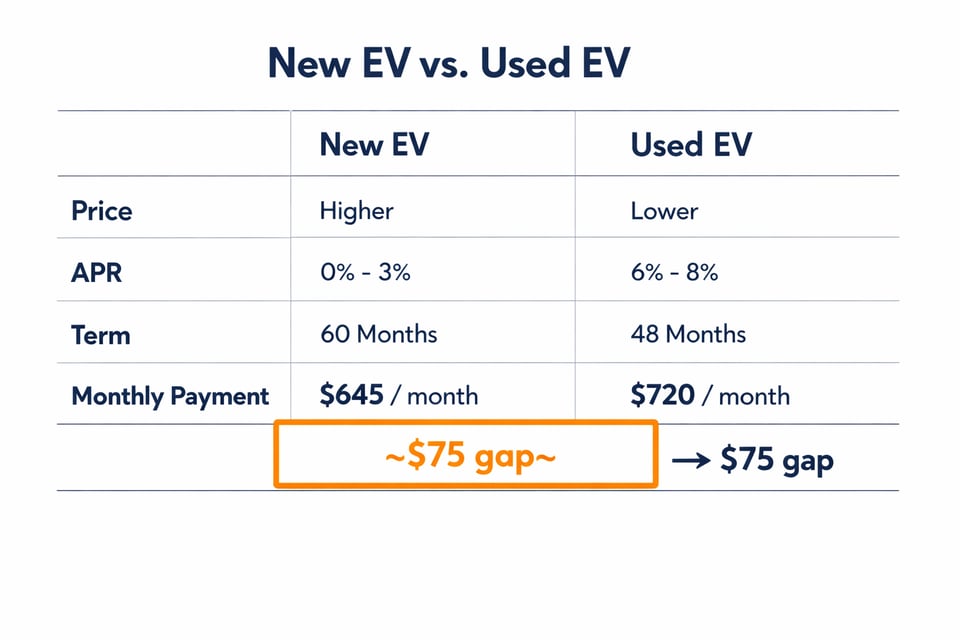
Example scenario (illustrative):
- New EV: lower APR + term support can keep payment surprisingly close
- Used EV (2 yrs old): higher APR can erase the price advantage faster than most teams expect
When the payment delta narrows under roughly $75–$100 (market-dependent), used EV elasticity tightens.
And that can happen before MMR moves.
Want the signals before they hit the scoreboard?
I send one operator-grade market brief each week—what’s changing, what it means for buying, and what to do next.
Subscribe to the PPO BriefWhy This Matters for “Attack Mode”
Attack mode requires:
- Spread expansion
- Wholesale weakness
- Retail confidence
- Elasticity room
Right now, we have tight spreads and wholesale firmness — but a payment gap that can compress quickly if new EV affordability improves.
That’s not an attack setup.
That’s a compression setup.
What I’m Watching Instead of Just MMR
If you want to stay signal-first, add these to your weekly discipline:
- Payment delta: comparable new EV vs used EV
- Term creep: 72 → 84 months (and where it shows up)
- Cash stacking depth: how much “help” is required to move new EVs
- Used EV days-to-sell vs ICE days-to-sell: elasticity shows up here first

The Debate
Everyone is debating battery disclosure.
Documentation matters — but documentation doesn’t decide margin.
Payment decides margin.
If new EV affordability quietly improves while used EV acquisition stays tight, the next squeeze won’t start at the auction.
It starts in the F&I office — and shows up later as “mysterious” used EV retail softness.
Signal-first operators watch incentives before they watch headlines.
Scoreboard watchers wait for MMR to move.
And by then, the spread is gone.