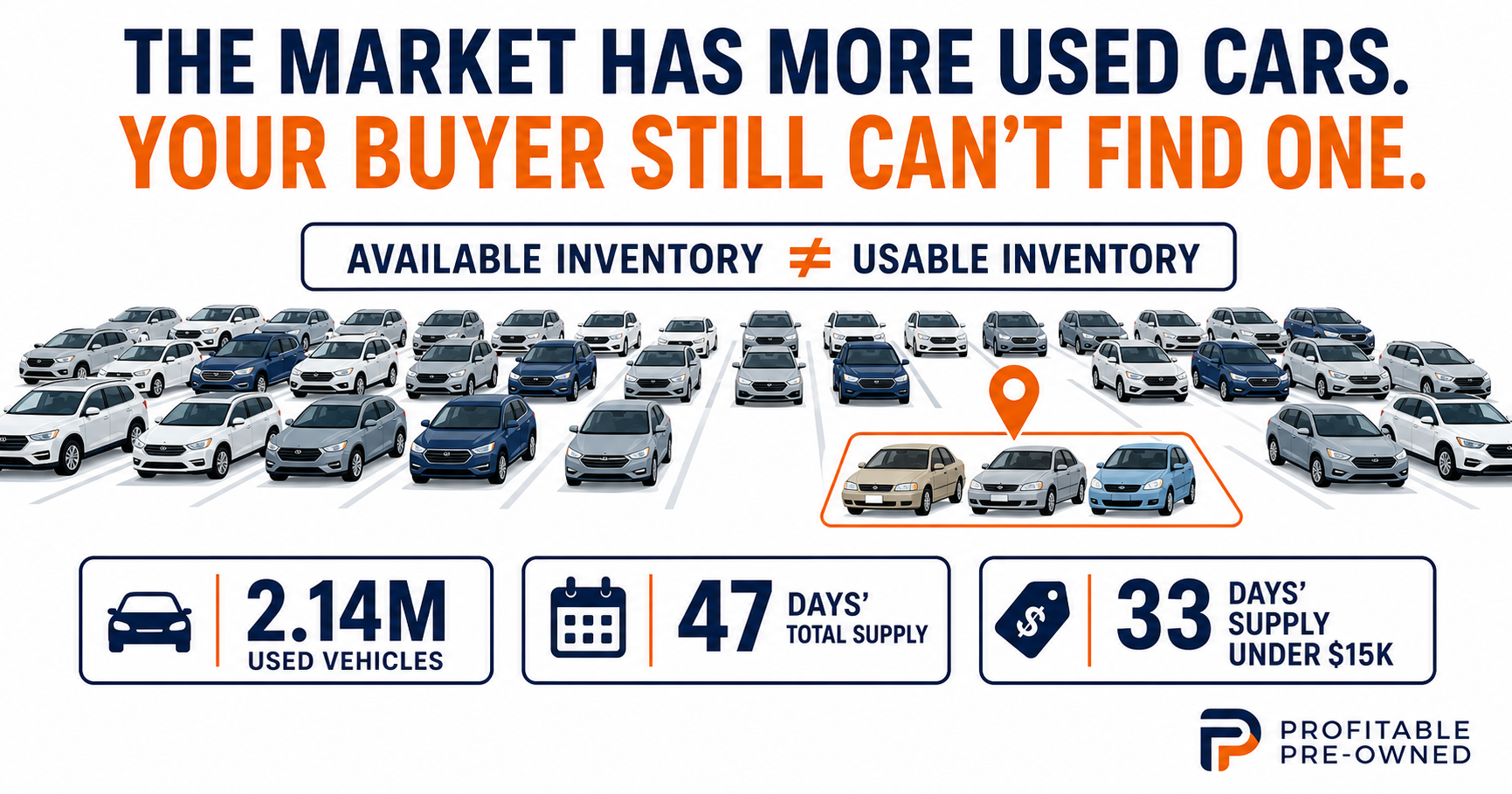
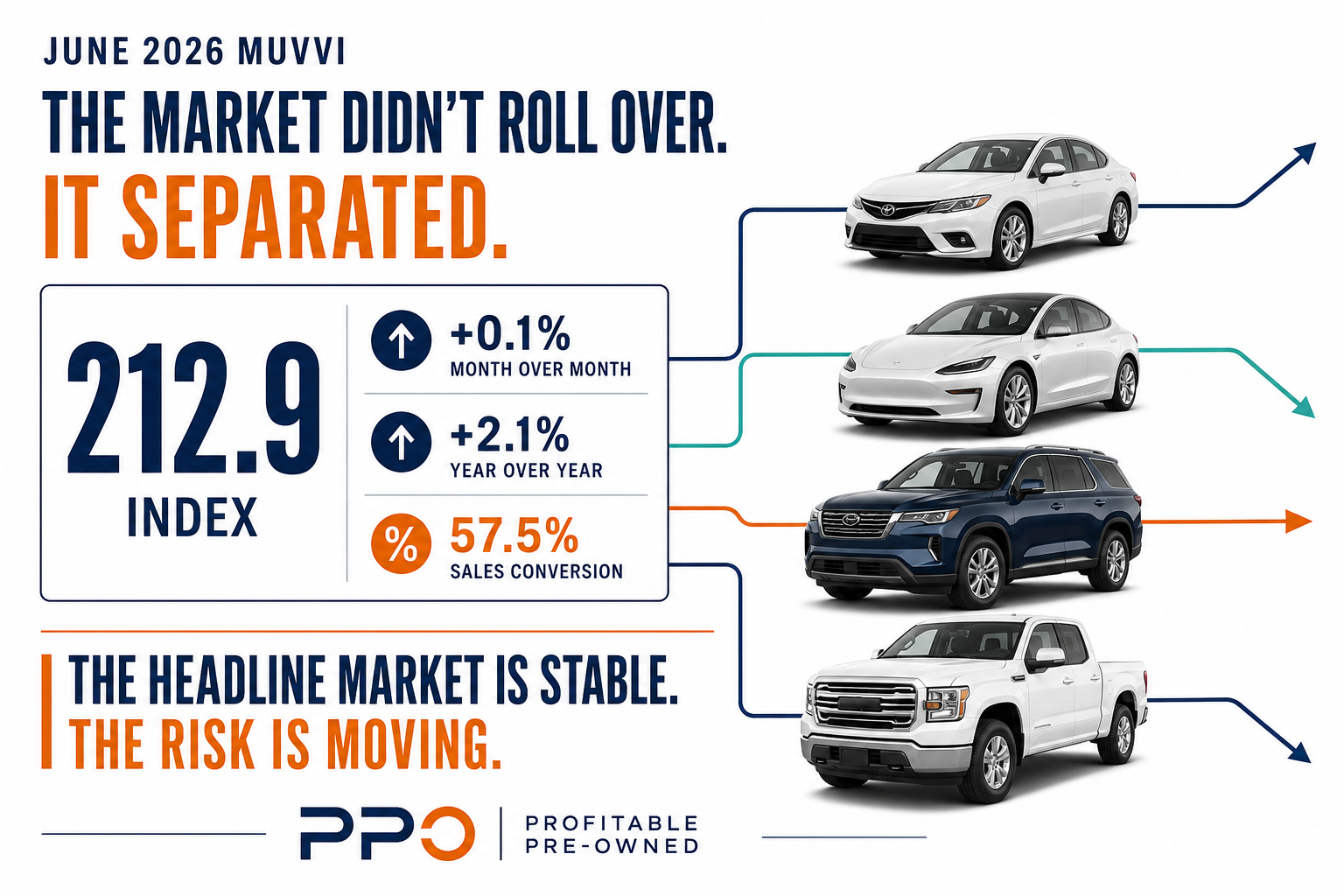

Wholesale used-car values remained stable in June. But underneath the headline, the market continued to separate by segment, price point, and powertrain.
The used-car market did not collapse in June.
It did not accelerate much either.
Instead, the June data showed a market that remains supported overall while becoming more selective at the vehicle level.
The June 2026 Manheim Used Vehicle Value Index finished at 212.9, up 0.1% from May and 2.1% from June 2025.
The June result came in below the typical seasonal increase for the month, but wholesale values still finished the first half of 2026 on solid footing.
- 3.6% above December 2025
- Only 1.1% below the March 2026 peak
- 57.5% sales conversion
- 26.9 days of wholesale supply
The PPO view is straightforward:
The wholesale market is not sending dealers one signal. It is sending several.
That distinction matters because a stable headline index can create false confidence.
The overall market may look balanced while individual vehicles, segments, and price bands are becoming materially more or less risky.
PPO Takeaway:
Do not buy the market. Buy the vehicle’s demand, supply, cost basis, and exit path.
1. Stable Wholesale Values Do Not Mean Every Vehicle Is Safe
The overall Manheim Index was nearly flat in June.
Non-seasonally adjusted wholesale prices, however, declined 1.3% from May while remaining 2.9% above last year.
That difference matters.
Seasonally adjusted data helps operators understand the direction of the broader market. The actual dollars moving through the lanes can still decline as the spring selling season ends and normal seasonal patterns return.
Dealers should not interpret the 2.1% year-over-year increase as permission to chase inventory or pay through the market.
The better interpretation is that wholesale values remain supported, but the rapid spring appreciation has normalized.
There is no reason to panic.
There is also no reason to loosen acquisition discipline.
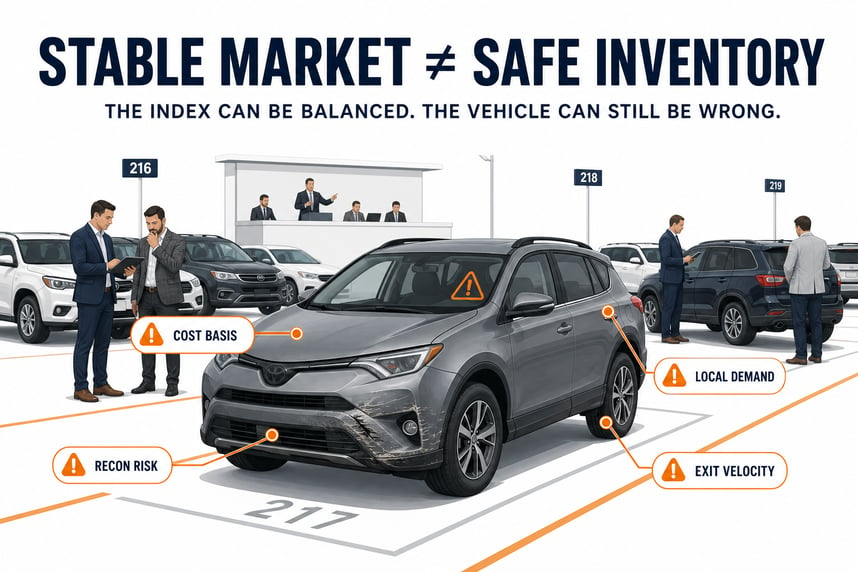
A stable market still punishes:
- Poor cost basis
- Excess recon exposure
- Weak local demand
- Slow retail velocity
- Unclear exit strategy
- Overconfidence based on the headline index
A stable market does not make every acquisition safe.
The market does not have to decline sharply for a dealer to lose margin. The dealer only has to own the wrong vehicle at the wrong cost.
2. Dealer Demand Remains Healthy
Sales conversion finished June at 57.5%.
That was lower than May, but it remained 2.6 percentage points above the recent three-year average for June.
Wholesale days’ supply reached 26.9 days, only slightly higher than May and 1.3 days above last year.
Together, those numbers suggest a relatively balanced used-car market.
Dealers are still competing for inventory.
Supply is available, but it has not expanded enough to create broad wholesale pressure.
This is where buyers can make an expensive mistake.
A healthy conversion rate can create the impression that a vehicle must be worth the money because multiple dealers are bidding.
Auction competition confirms demand in the lane. It does not confirm your retail exit.
Before increasing the bid, the acquisition still has to work against:
- Local inventory depth
- Recon expense
- Retail pricing position
- Expected turn time
- Capital exposure
- The store’s current inventory posture
A crowded auction lane can validate wholesale demand.
It cannot validate your retail strategy.
3. Affordability Is Becoming the Center of the Market
Cox Automotive identified affordability as one of the defining themes of the first half of 2026.
Older vehicles experienced stronger appreciation, while compact cars and other affordable segments showed relative strength.
That is not surprising.
New-vehicle prices, monthly payments, insurance expenses, and borrowing costs continue to push more customers toward lower price points.
For used-car departments, this changes the operating question.
The question is no longer whether the store should carry affordable vehicles. The question is whether the store can operate them profitably.
Affordable inventory is particularly sensitive to operational cost.
Common margin leaks include:
- Excessive recon
- Slow mechanical inspections
- Delayed title processing
- Weak merchandising
- Poor financing coverage
- Price changes that come too late
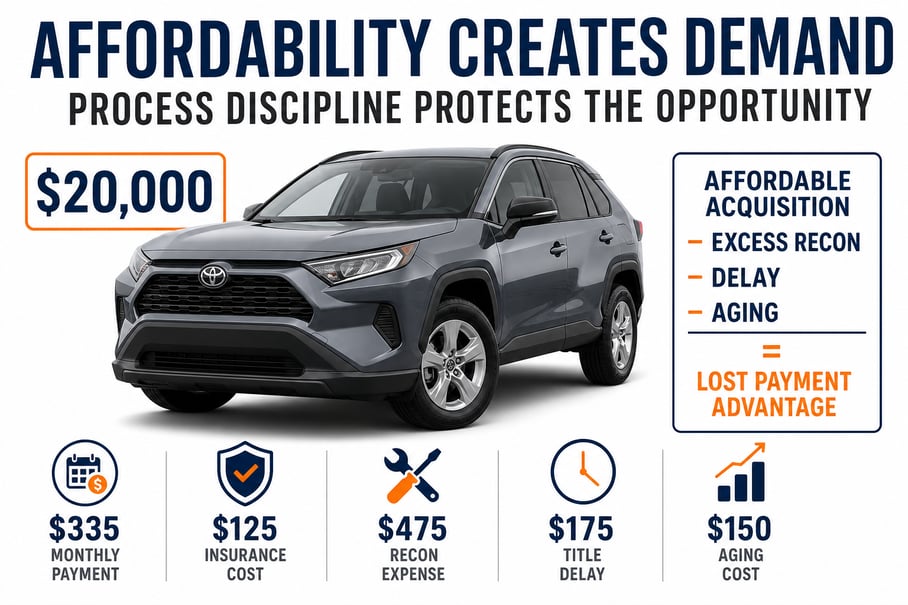
A $20,000 vehicle may have strong customer demand, but the payment advantage can disappear quickly after unnecessary recon, fees, and aging expenses are added.
Affordability creates the demand.
Process discipline protects the opportunity.
Dealers that want to win in lower price bands need more than acquisition access.
They need faster recon decisions, cleaner merchandising, disciplined pricing, and tighter cost control.
4. Used-EV Strength Is Real, but It Requires an Exit Plan
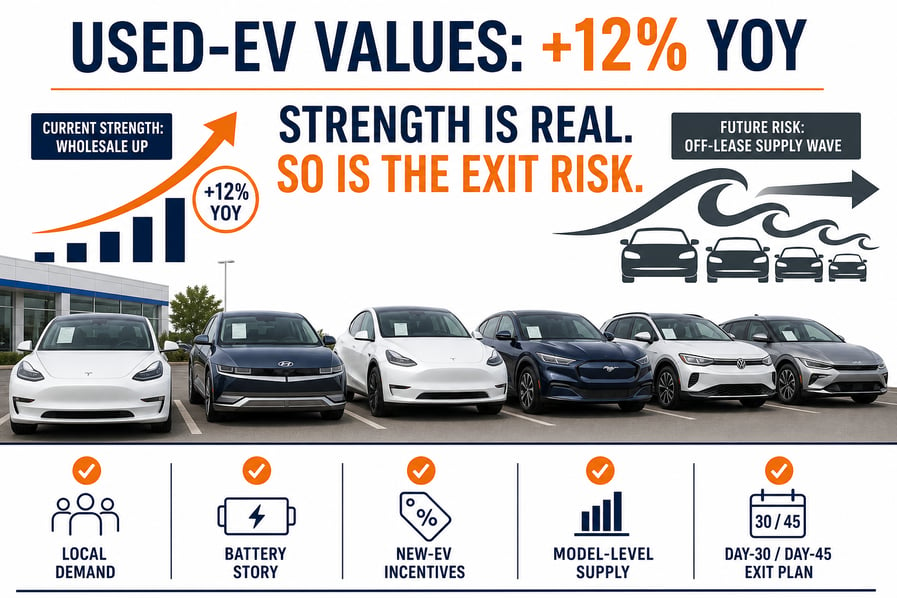
The June EV Index increased 12% year over year and 1.7% from May.
The Non-EV Index increased only 1.7% year over year and 0.2% from May.
That is a meaningful gap.
Used EVs are benefiting from:
- Lower acquisition costs
- Improved affordability compared with new EVs
- Greater consumer awareness
- More model availability
- Stronger value comparisons at certain price points
But the index measures what has already happened.
It does not guarantee what happens next.
Cox Automotive also identified increasing off-lease EV supply as a potential risk for the second half of 2026.
If additional supply arrives while fuel prices remain low or new-EV incentives become more aggressive, specific used-EV models could face pricing pressure even if the overall market remains stable.
This is why dealers should not create one broad used-EV buying rule.
Every used-EV acquisition should include:
- A local demand check
- A clear battery and condition story
- A comparison with current new-EV incentives
- A model-level supply review
- A defined day-30 and day-45 exit plan
Used EVs may offer some of the strongest acquisition opportunities in the market.
They can also create some of the fastest depreciation mistakes.
The difference is whether the vehicle was acquired with a defined retail and exit strategy.
For a deeper operating framework, review the Used EV Market Playbook.
5. SUVs and Pickups Need More Precision
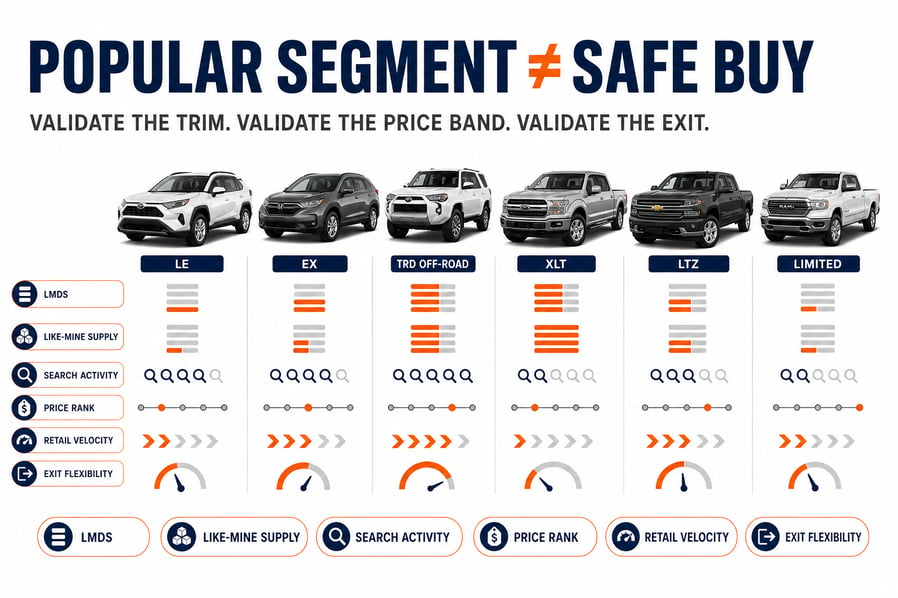
Cox reported that SUVs and pickups showed weaker year-over-year wholesale price performance than the overall market.
That does not mean dealers should stop buying them.
It means buyers should stop treating broad segment popularity as proof of current demand.
A pickup may have a strong historical sales story and still be the wrong acquisition because of:
- Trim saturation
- Equipment mismatch
- Excess local supply
- High recon exposure
- An unrealistic retail price target
- Weak demand at the exact price point
The same applies to SUVs.
The vehicle type may be popular.
The exact configuration may not be scarce.
This is where vehicle-level signals should overrule personal preference.
Dealers should evaluate:
- Local Market Days Supply
- Competitive inventory depth
- Search activity
- Price rank
- Retail velocity
- Like-mine availability
- Exit-pricing flexibility
A buyer can be right about the category and still be wrong about the vehicle.
Broad market confidence should never replace model-level and trim-level discipline.
The PPO Operator Response
The June 2026 Manheim Used Vehicle Value Index supports five immediate operating actions.
1. Separate the Market by Price Band
Do not use one inventory strategy for a $19,000 compact car and a $48,000 pickup.
Demand, financing, recon tolerance, and exit risk are different.
Your buying rules should be different too.
2. Protect Affordable Inventory From Operational Cost
Measure recon time and expense as aggressively as the acquisition price.
The longer an affordable vehicle waits for inspection, parts, photos, title work, or pricing, the more quickly its payment advantage disappears.
3. Give Every Used EV a Written Exit Plan
Do not wait for increasing supply to reveal the absence of one.
Every used EV should have a defined day-30 and day-45 decision before the vehicle is purchased.
4. Recheck SUV and Pickup Scarcity
Historical popularity is not the same as current model-level demand.
Use local supply, trim depth, search behavior, and retail velocity to validate the buy.
5. Avoid Chasing the March Market
Wholesale values remain supported, but the spring acceleration has already normalized.
Do not anchor current bids to the strongest part of the year.
Buy to today’s signal, not yesterday’s momentum.
The headline market is stable.
The risk underneath it is moving.
PPO Takeaway
The overall used-car market remains balanced.
The inventory underneath it does not.
The second half of 2026 will reward operators who can separate the headline from the actual vehicle-level signal.
A stable Manheim Index does not make every acquisition safe.
It only tells you that the broader market remains supported.
Your margin will still be determined by:
- What you buy
- What you pay
- How quickly you recon it
- How accurately you merchandise it
- How early you recognize the exit decision
The market does not have to collapse for a dealer to experience a margin problem.
The dealer only has to own the wrong vehicles at the wrong cost.
Do not just watch the market.
Turn the signal into a better acquisition, pricing, and exit plan.
Subscribe to the PPO BriefBottom Line
The June 2026 Manheim Used Vehicle Value Index does not show a market rolling over.
It shows a market separating.
Affordable vehicles are holding up better.
Used-EV values are rising faster.
SUVs and pickups require more precision.
Dealer demand remains healthy, but auction competition cannot replace a retail exit strategy.
The dealer response is operational:
- Separate buying rules by price band
- Protect affordable units from recon and aging expense
- Give every used EV a written exit plan
- Validate SUV and pickup demand at the trim level
- Buy to today’s market instead of chasing spring momentum
That is how dealers protect capital, reduce unnecessary risk, and preserve gross in a market where the headline looks stable but the opportunity is becoming more selective.
Source: Cox Automotive, “Manheim Used Vehicle Value Index: June 2026 Trends.”
Additional comparisons with December 2025 and the March 2026 peak were calculated from the June 2026 Manheim Used Vehicle Value Index data workbook.
-2.png)